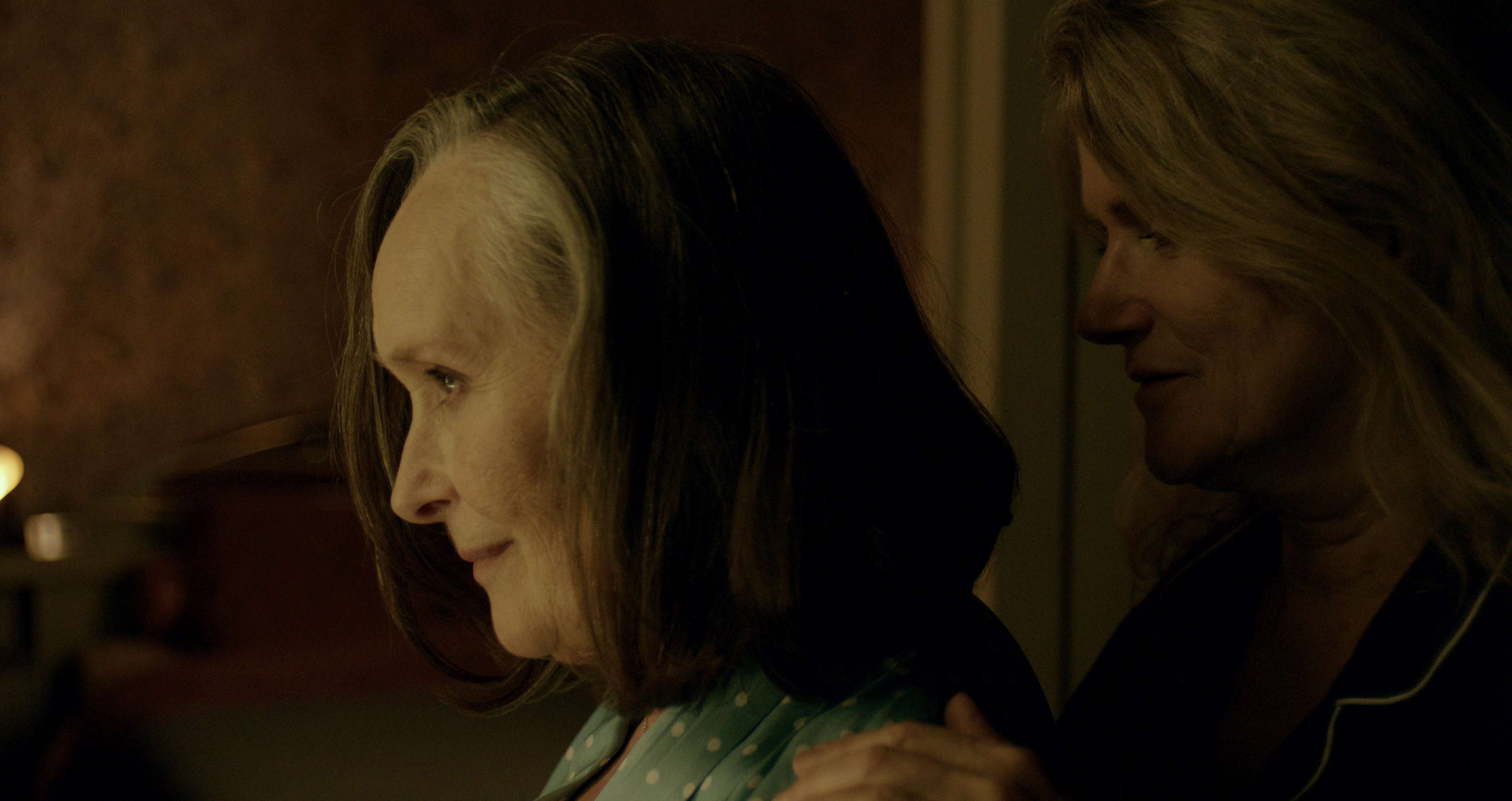
Fassbinder favourite Barbara Sukowa gives a fine performance in this touching but rarely sentimental film which depicts a lesbian relationship between two pensioners; it's far removed from the likes of Blue is the Warmest Colour or current critical smash Portrait of a Lady on Fire, but, considering its focus on a couple of a certain age, it's arguably a more daring picture than those two Cannes-winning titles. It's also a most assured feature debut from Filippo Meneghetti, who carefully handles material which could easily have ended up as overcooked as the scorched contents of the two frying pans which feature in key scenes here.
Sukowa's Nina lives across the hall from Madeleine (Martine Chevallier), and to everyone in their lives they're viewed as simply being friends and neighbours. However, the two have actually been a couple for many years, and are now planning on moving to Italy. Nina has no family, but the widowed Madeleine has two grown-up children and a grandson, all of whom live in the same town as her. Madeleine resolves to tell her family about her plans to sell up and move away, but bottles it at the crucial moment. Nina is furious, and lets Madeleine know it; shortly afterwards, Madeleine suffers a major stroke. In a very short span of time, Madeleine and Nina's relatively minor problem of how to break some news has been replaced by something truly shattering.
With surly round-the-clock carer Muriel (Muriel Bénazéraf) now looking after the stricken Madeleine, Nina no longer gets to spend much time with the love of her life, and her attempts to rectify this involve increasingly risky - and, to be honest, rather creepy - methods. In addition to the belligerent Muriel, Nina must contend with Madeleine's daughter Anne (Léa Drucker, excellent), who initially appreciates Nina's neighbourliness - until the penny drops. Upon realising what was going on behind her late father's back for so many years, Anne is in no mood to grant Nina any further access to Madeleine, who is now showing some small signs of recovery.
With the impressive Chevallier's Madeleine rendered mute for much of the film, it's not too surprising that this ends up largely being Sukowa's show, and she certainly puts it all in with a character who isn't, in the main, terribly likeable, yet the love and devotion she exhibits often serves to cancel out her bad behaviour - at least in the viewer's eyes. But it's the tenderness at the heart of the relationship between these two women which elevates the film into something way beyond ordinary, and in Two of Us Meneghetti has crafted an authentic, moving and grown-up piece of cinema, one which hopefully won't fly under the radar. It screens at the London Film Festival tomorrow and on Saturday.
The Culture is a collection of eight short films which screens at the London Film Festival on the 11th and 13th of October, and every film in the programme takes a look at online culture - something which only recently seemed very futuristic but is now firmly embedded in our everyday lives. I've only seen a quarter of the films which feature in The Culture, but the ones I've watched have been quite impressive; on this basis, the other 75% of the programme should be worth catching. The selection includes one film from the Netherlands and two from Belgium, although Belgian title Zombies - a co-production with DR Congo - has thus far eluded me.
The Belgian film in the programme which I have seen is #21XOXO - a clever, witty and rather adult slice of animation which sees a young woman use various forms of technology in her search for love. As we all know, it's now possible to line up potential partners without even leaving the comfort of home, which is exactly what our protagonist does here; while such practice isn't especially new, it's nonetheless a significant marker of how social interaction has dramatically changed since the advent of new technologies, and the film reminds us of this as it forces us to consider our online selves. #21XOXO is a fun, refreshing and colourful short, one which turns up something new just when you thought there wasn't much left to say about those who spend their days glued to one screen or another.
The Dutch offering in TheCulture takes the form of The Sasha, a contemplative look at the work of astronaut Charles Duke, who was a member of the three-man crew on the Apollo 16 mission. Among his other lunar duties, Duke was charged with taking photographs, and it's this aspect of his work in the Descartes Highlands that The Sasha focuses on. Duke attempted to take a photo of the entire Earth from space, but the iconic image we all know as The Blue Marble was actually taken during the next (and final) Apollo mission. There's a fascinating personal touch in the Apollo 16 story: Duke left a picture of himself, his wife and their two sons on the lunar surface, which he of course photographed. On the back was an inscription: "This is the family of Astronaut Duke from Planet Earth. Landed on the Moon, April 1972",followed by the signatures of Duke's family. In addition to their virtual visit to the moon via this photograph, Duke's wife and sons had lunar craters named after them.
Nowadays, we can all enjoy a lunar excursion of sorts thanks to Google Moon (where the Duke family photo can be found at marker 20 in the Apollo 16 site), and footage from this has been used in The Sasha; thus, the film features the traditional chemical photography of Duke's pictures alongside the sophisticated 3D rendering of the moon's surface as provided by Google. This illustrates just how far technology has advanced in the years since Apollo 16 (although we haven't set foot on the moon since the year of that mission). As such, it's easy to see why the film has been grouped with #21XOXO, even if the two films boast very different styles. The Sasha proves to be a hypnotic, eerie and thought-provoking work, one which will leave you reflecting on that old family photograph which, although now almost certainly bleached beyond all recognition, remains up there on the lunar highlands.
Dutch actor Marwan Kenzari enjoyed a huge international breakthrough just a few months ago, starring as Jafar in the live-action version of Aladdin. His role in Instinct - which opened in the Netherlands last week and plays at the London Film Festival on Saturday - is markedly different to the one he played in that Disney blockbuster; while still very much the villain of the piece, his character in Halina Reijn's directorial debut is far removed from the pantomime shenanigans of the Grand Vizier. In Instinct, Kenzari conveys a very real menace which underlines his abilities as a serious dramatic actor. Unfortunately, he and his co-star Carice van Houten are let down by a faltering script and rather uncertain direction, and Instinct never lands the knockout blow which, judging by its arresting early stages, it seems certain to deliver.
Van Houten's Nicoline is a psychologist who moves from job to job and doesn't appear to have much interest in staying in the one place for too long; her latest gig involves working in a prison for those convicted of serious offences. Nicoline is experienced and assured, and few things seem to faze her, but this soon changes when she's charged with evaluating Idris (Kenzari), a man with multiple convictions - all of which pertain to violence against women. Idris, who is on the verge of some unaccompanied parole, is clearly a very dangerous man but seems to be a fairly compliant inmate, and can often be quite charming - which is, presumably, how he snared many of those who went on to become his victims. Idris' act - if it is an act - seems to persuade Nicoline's colleagues that he has been rehabilitated, but his assigned psychologist has real doubts.
While Nicoline appears to have the measure of Idris - you get the impression she's seen similar men countless times - there's something about this particular prisoner which gnaws away at her in a way she can't rationalise, and it's not long before her icy professionalism goes out of the window. What follows is an increasingly preposterous game between Idris and Nicoline, one which sees the psychologist unravel as the prisoner toys with the mind of a woman who could well determine which side of the prison wall he ends up on. Who's kidding who? More pertinently, who cares? In pitching the charismatic Idris against the aloof Nicoline, Reijn has created a strange level playing field, of sorts: Idris, unlike Nicoline, often seems to be doing things by the book, but does this current state of affairs mean we should blot out his terrible crimes? After all, Nicoline's transgressions appear to be limited to this anomalous instance of unprofessionalism.
Instinct's promisingly pulpy setup is the sort of thing which might just have worked in the mischievous hands of, say, François Ozon or Paul Verhoeven (side-note: Van Houten and Reijn both starred in Verhoeven's Zwartboek); the material really needs cranking up to a level where it would become enjoyably absurd (cf. Elle, L'amant double). But Halina Reijn - who we're far more used to as a presence in front of the camera - seems to consciously pull back from such an approach, rendering Instinct an ostensibly trashy yarn that's had its guilty pleasures excised; it's a film caught between two stools. It isn't a terrible movie - but it is a very frustrating one; while the two leads are very good, they're chained to a script which misses many opportunities to open up into something much more satisfying. While Reijn hasn't made a bad job of her first feature film, she has opted to play it far too safe; given the subject matter, it seems most ironic that Instinct comes across as a film in which very few risks have been taken.