Tuesday, 7 April 2026
Reflection in a Dead Diamond (H. Cattet/B. Forzani, 2025)
Saturday, 28 February 2026
Kontinental '25 (Radu Jude, 2025)
Thursday, 22 January 2026
IFF Rotterdam 2026: Four Films in Festival Competition
Monday, 3 November 2025
The North (Bart Schrijver, 2025)
Sunday, 12 October 2025
The Deal (Jean-Stéphane Bron, 2025)
The Deal is a six-part TV series that tells the story of the 2015 US-Iran nuclear negotiations, which took place in the very neutral state that is Switzerland. Focusing on Geneva-based chief of protocol Alexandra Weiss (Belgian actress Veerle Baetens), the show—the first two episodes of which screen today at the BFI London Film Festival—provides an engrossing insight into these sensitive diplomatic talks. The entire series is directed by Jean-Stéphane Bron, and this material feels a particularly good fit for a filmmaker who became known for his political documentaries—including L'expérience Blocher—before branching into fiction.
Weiss is a sort of diplomatic factotum, and the early stretches of the show focus on her seemingly endless duties as she attempts to smooth the ground for the negotiations. She's serious, measured, and does her utmost to remain unruffled—even when being talked down to by Fenella Woolgar's ghastly EU delegate. It is difficult to imagine the rather inscrutable Alexandra having any kind of private life, but this all changes with the introduction of her ex, Iranian scientist-engineer Payam Sanjabi (Arash Marandi), who has been released from prison so that he can play a role in the discussions; suddenly, we see a different side to her.
Sanjabi's arrival demonstrates how the series deftly combines the personal with the political, an aspect of the show that is underlined by a fraught telephone call between the US Secretary of State (Juliet Stevenson) and her aging, ailing mother. The ever-dependable Stevenson is good value in the part, and her scenes with her Iranian counterpart (Anthony Azizi)—who doesn't consider her his equal—crackle and fizz in a way that adds real dramatic heft to the proceedings. There's also a notable role for André Marcon, an actor perhaps best known for his work with Jacques Rivette, including the epic two-part film Joan the Maid.
But The Deal is glued together by Veerle Baetens, who excels as the put-upon Alexandra. She's an assured, magnetic presence, and one suspects that her recent experience behind the camera—her directorial debut, the Belgian-Dutch co-production Het smelt, won Best Flemish Film at last year's Magritte Awards—has helped her further refine her technique as a performer. Baetens carries the series with this complex character, one who must always remain impartial as the often bullish participants—who appear more concerned with not losing face than reaching an agreement—constantly threaten to derail the negotiations.
Wednesday, 7 May 2025
Cannes Film Festival 2025: Belgian Selections
Monday, 14 April 2025
Hot Milk (Rebecca Lenkiewicz, 2025)
Hot Milk, the directorial debut of Ida screenwriter Rebecca Lenkiewicz, is a beguiling adaptation of Deborah Levy's eponymous Booker-shortlisted novel. Lenkiewicz's film, which premiered at the Berlinale and was selected for last month's BFI Flare, examines the knotty relationship between Sofia (Emma Mackey) and her controlling single mother Rose (Fiona Shaw), who are staying in an apartment in the Spanish coastal city of Almeria. But despite the sun-dappled locale, this is no holiday: Rose is receiving treatment from a local doctor, Gómez (Vincent Perez), for an undiagnosed condition that confines her to a wheelchair.
As Sofia seeks some respite from her rather suffocating domestic situation, she encounters—and becomes enamoured with—flighty bohemian Ingrid (Vicky Krieps), yet this dalliance eventually proves as frustrating as the fraught relationship with her mother. Sofia decides to mix things up by heading to Greece (which is in fact where the entire film was shot) to visit her father (Vangelis Mourikis), who now has a new family and is unable to provide much in the way of the fulfilment she so obviously craves. In a development that underlines Rose's extremely manipulative nature, Sofia is abruptly recalled from her Greek sojourn.
Clearly, Rose is a very damaged individual, and it's implied that her symptoms are largely psychosomatic. Yet Shaw's immense, nuanced performance leads us to both pity and scorn this troubled soul, who dismisses the incremental academic progress made by Sofia while simultaneously cherishing it as a means to infantilise her daughter, therefore preventing her from growing up and flying the nest. For her part, Sofia—whose doctorate is currently on hold, at least partly because of Rose's treatment—alternates between dutifully caring for her mother and barely tolerating her endless, grating requests for suitable drinking water.
Mackey, hitherto best known for the Netflix series Sex Education, responds to the marker laid down by Shaw and delivers a turn to match that of her seasoned co-star, while Luxembourgish actress Krieps is good value in a rare supporting role. Given that Levy's book is one in which much hinges on Sofia's interior life, translating it to the screen is no easy task. When reviewing a title from last year's Flare—Orlando, My Political Biography—I wrote about the challenges of adapting such novels; as with that film, the haptic, hypnotic Hot Milk takes a sideways approach to adaptation, and the results are highly impressive.
Wednesday, 20 April 2022
Films of the New French Extremity (1–31/5/22)
The BFI have announced full details of CRUEL FLESH: FILMS OF THE NEW FRENCH EXTREMITY, a season of brutally compelling films that explore intimacy in a violent world. Running throughout May at BFI Southbank, the programme explores the unique moment in cinema history that sent shockwaves through arthouse sensibilities. This season will feature the work of filmmakers such as Claire Denis (TROUBLE EVERY DAY), François Ozon (CRIMINAL LOVERS), Leos Carax (POLA X), Marina de Van (IN MY SKIN), Lucile Hadžihalilovic (LA BOUCHE DE JEAN-PIERRE, with Hadžihalilovic attending in person), and Gaspar Noé, the latter of whom will also be subject of a special focus in May.
FOCUS ON: GASPAR NOÉ coincides with the release of the filmmaker’s new work VORTEX (2021), and
will include in person appearances from the director. The centrepiece event of the focus will be Gaspar
Noé in Conversation on 10 May, during which the one-of-a-kind filmmaker will reflect upon his work
so far, including VORTEX, which will be on extended run at BFI Southbank when it is released in
cinemas UK-wide on 13 May. IRREVERSIBLE (2002) is built around Vincent Cassel and Monica Bellucci, trading on
their popularity and charisma as a real-life couple to make their violent descent even more assaulting. In 2019, Noé returned to
the film to tell the story in chronological order; IRREVERSIBLE: THE STRAIGHT CUT (2002) goes beyond
a linear reassembling of the narrative.
Contextual events during the NEW FRENCH EXTREMITY season will including opening event SEX AND DEATH, BUT MAKE IT ARTHOUSE, a richly illustrated talk on 3 May that will introduce the key titles, filmmakers and thematic preoccupations of this distinct film movement. There will also be an online panel discussion – HORROR À LA FRANÇAISE – available for free on BFI YouTube from 11-31 May. As part of the season a four-session course running every Tuesday – CITY LIT AT THE BFI: NEW FRENCH EXTREMITY – will consider the historical, cultural, social and political context for this phenomenon and seek to examine a number of these films in detail. There will also be a NEW FRENCH EXTREMITY collection on BFI Player, available concurrently with the BFI Southbank season.
The closest thing to a comedy to be found in this programme, MAN BITES DOG (Rémy Belvaux/André Bonzel/Benoît Poelvoorde, 1992) is a Belgian mockumentary that follows a crudely charismatic serial killer who is delighted to be the subject of a documentary that will cover his thoughts on the ‘craft of murder’ and classical music. In the exceptionally creepy Belgian horror THE ORDEAL (Fabrice du Welz, 2004), a traveling entertainer becomes stranded in a remote mountain town and is taken in by an affable local, who nurtures a dangerous obsession. Without any women or music, Fabrice du Welz deliberately avoids horror clichés to make something truly strange.
Source/images: BFI
Thursday, 19 December 2019
On a Magical Night (Christophe Honoré, 2019)
On a Magical Night marks the sixth collaboration between director Christophe Honoré and actress Chiara Mastroianni, and it follows the general rule that these two are at their best when working with each other. While Love Songs remains the pinnacle of the pair's work together, On a Magical Night - which reunites Honoré and Mastroianni for the first time since 2011's Beloved - sees the two drive each other on to good effect. Mastroianni picked up the best performance award in Cannes' Un Certain Regard section for On a Magical Night, a film which sees her equal Louis Garrel's record of half a dozen stints in front of the camera for Honoré. The cast is rounded out by Vincent Lacoste (who returns from Honoré's previous film Sorry Angel), the excellent Camille Cottin, Benjamin Biolay, plus some serious star power in the form of the welcome presence of Carole Bouquet, who doesn't make enough films these days.
Mastroianni's Maria has been married to Richard (Biolay) for 20 years, and the couple have now hit a wall in their relationship. Following a major argument, Maria moves out of their apartment, but doesn't go very far - in fact, she checks in to the hotel directly across the street from the marital home. From her room in the hotel, she can watch Benjamin moping around in the aftermath of their row; the particular room Maria's holed up in - 212 - carries significance, as its number is shared by a section of civil code which outlines spousal obligations. So far, so straightforward, but events take a strange turn when Maria is visited by a ghost from the past in the form of the young Richard (Lacoste). From this younger version of her husband, Maria learns all about Richard's first love Irène (Cottin), who soon joins the couple in the hotel room. Like Richard, Irène has also turned the clock back, and appears to be the age she was when she and Richard were in a relationship. All of this gives the initially baffled Maria - who remains her actual age throughout - plenty to think about as she considers both the state of her marriage and her next move.
As a studio-bound affair featuring just a handful of actors, On a Magical Night could quite easily be a play (and Honoré is no stranger to theatre), yet at no point does it feel stagey. While much of the action takes place in the hotel room, Honoré lets his film breathe via a late seaside scene and, most memorably, the road which separates Maria's hotel and apartment. Shots of this avenue play a big part in creating the film's wonderfully rich atmosphere; as the snow begins to fall on this quiet street - which prominently features a seven-screen cinema - the beauty of the mise-en-scène is something to behold. However, the icy spectacle also serves to remind us that Richard and Maria are in the winter of their relationship, and it's going to take a mighty big snow shovel to dig them out of it.
While there isn't a weak link among the small cast, and Mastroianni is as good as we've come to expect, it's actually Camille Cottin who steals every scene she's in; since starting off in a series of two-minute sketches for TV, Cottin has racked up an impressive list of film credits and has shown that she has range beyond comedy, with her turn as a no-nonsense detective in Iris proving how good she can be in a serious dramatic role. While On a Magical Night certainly falls on the lighter side of drama and has some gently humorous moments, Cottin expertly brings out the pathos in her character, yet is always ready to utilise her impeccable comic timing when required. But to focus exclusively on Cottin would be to do a disservice to Honoré and the rest of his fine cast, who have here created an atmospheric, intelligent and engaging work, one which could even be said to be rather - ahem - magical.
Darren Arnold
Images: image.net
Thursday, 10 October 2019
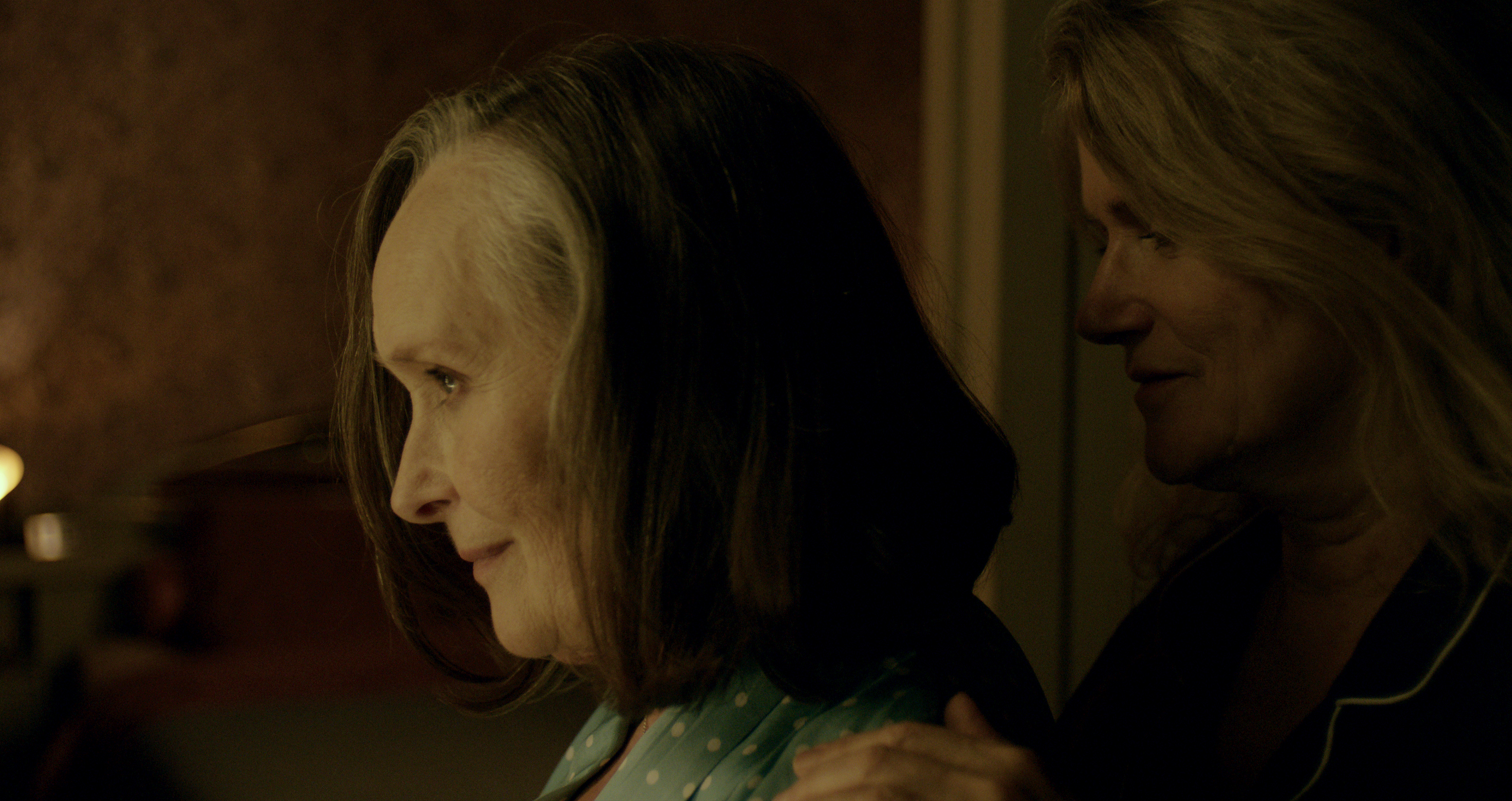
Two of Us (Filippo Meneghetti, 2019)
Darren Arnold
Images: Dulac Distribution
Sunday, 6 October 2019
The Prince's Voyage (J-F. Laguionie / X. Picard, 2019)
Xavier Picard, director of the excellent Moomins on the Riviera, teams up with veteran animator Jean-François Laguionie for this quasi-sequel to the latter's 1999 film A Monkey's Tale. Laguionie has been working in animation for over 50 years yet, A Monkey's Tale aside, his work isn't especially well known beyond continental Europe. While Laguionie's films bear similarities, in both mood and appearance, with those of Michel Ocelot, he's never really experienced anything like the same success as that enjoyed by his lauded contemporary (as a side note, Ocelot's BAFTA-winning The Three Inventors was filmed in Laguionie's home). That said, Laguionie did receive an honoray award (and a standing ovation) at this year's Annecy IAFF, where A Prince's Voyage premiered; it continues its festival run at the London Film Festival, where it screens today as part of the Family programme. The film will go on general release in early December.
When Prince Laurent is washed up on an unfamiliar shore, he's rescued by young Tom, whose name is just one letter away from that of Kom, the main character from A Monkey's Tale; Laurent notices, and comments on, this similarity. Tom takes the injured Laurent to convalesce at the home of married couple Victor and Elisabeth who, like Tom and Laurent, are monkeys, as indeed are all the characters who populate the film. Elisabeth is a botanist who is working to find a solution to the forest which seems bent on reclaiming every building it comes across, including the remote, abandoned museum where the couple now reside. Victor is a professor who has long been obsessed with proving that other monkey civilisations exist on the same planet, a theory which has made him a black sheep in his academic circle. So when Laurent - who speaks, but in another language - arrives, Victor sees the prince as a golden chance to prove his hypothesis to his peers. Laurent is cultured and sophisticated, but, in scenes which nod towards François Truffaut's The Wild Child, acts in a primitive manner simply to irk the professor.
While Laurent doesn't care for the professor or the stern Elisabeth, he's far more taken with Tom, and the two enjoy spending time together, learning each other's language and trading stories about their different cultures. This shared curiosity gives Laurent and Tom the urge to discover the sights of the nearest city, and the pair sneak out to spend a night exploring various metropolitan delights. Laurent is struck by the sullen nature of the city dwellers, who fail to respond to his cheerful greetings as they trudge home after a day's work. The city's population are allowed to have fun in the evenings, however, and Laurent and Tom join them in various leisure activities, including a showing of a film which, amusingly, riffs heavily on King Kong. As the only member of the audience who's laughing at the spectacle, Laurent has to leave the screening, and as he and Tom begin to head home they are pursued by some shadowy figures; the prince's fortunes are about to take a turn for the worse.
As you'd expect, the animation in The Prince's Voyage is top notch, and at 77 minutes the film by no means outstays its welcome - although a late development which introduces some new characters feels slightly unnecessary. As with much of the aforementioned Michel Ocelot's output, The Prince's Voyage isn't the ideal film for very young children; the LFF screening is subtitled - although an actor will read out the subtitles, via headphones, for the benefit of younger audience members - which is rather telling. Unless a version with English audio exists (or is planned), the film probably won't travel much further than the majority of Laguionie's efforts. While it's all a little bit low-key, there is much to like here, and the simple, clear message - that we shouldn't be afraid of the Other, but rather should look to what unites us all - is a fine one for children and adults alike.
Darren Arnold
Images: image.net


.jpg)


.jpeg)


.jpg)


.jpeg)