The Deal is a six-part TV series that tells the story of the 2015 US-Iran nuclear negotiations, which took place in the very neutral state that is Switzerland. Focusing on Geneva-based chief of protocol Alexandra Weiss (Belgian actress Veerle Baetens), the show—the first two episodes of which screen today at the BFI London Film Festival—provides an engrossing insight into these sensitive diplomatic talks. The entire series is directed by Jean-Stéphane Bron, and this material feels a particularly good fit for a filmmaker who became known for his political documentaries—including L'expérience Blocher—before branching into fiction.
Weiss is a sort of diplomatic factotum, and the early stretches of the show focus on her seemingly endless duties as she attempts to smooth the ground for the negotiations. She's serious, measured, and does her utmost to remain unruffled—even when being talked down to by Fenella Woolgar's ghastly EU delegate. It is difficult to imagine the rather inscrutable Alexandra having any kind of private life, but this all changes with the introduction of her ex, Iranian scientist-engineer Payam Sanjabi (Arash Marandi), who has been released from prison so that he can play a role in the discussions; suddenly, we see a different side to her.
Sanjabi's arrival demonstrates how the series deftly combines the personal with the political, an aspect of the show that is underlined by a fraught telephone call between the US Secretary of State (Juliet Stevenson) and her aging, ailing mother. The ever-dependable Stevenson is good value in the part, and her scenes with her Iranian counterpart (Anthony Azizi)—who doesn't consider her his equal—crackle and fizz in a way that adds real dramatic heft to the proceedings. There's also a notable role for André Marcon, an actor perhaps best known for his work with Jacques Rivette, including the epic two-part film Joan the Maid.
But The Deal is glued together by Veerle Baetens, who excels as the put-upon Alexandra. She's an assured, magnetic presence, and one suspects that her recent experience behind the camera—her directorial debut, the Belgian-Dutch co-production Het smelt, won Best Flemish Film at last year's Magritte Awards—has helped her further refine her technique as a performer. Baetens carries the series with this complex character, one who must always remain impartial as the often bullish participants—who appear more concerned with not losing face than reaching an agreement—constantly threaten to derail the negotiations.
Today marks the start of this year's BFI Flare, which gets underway with two screenings of Amrou Al-Kadhi's debut feature Layla—a film that serves as the festival's opening night gala. But tomorrow is when the event gets properly up and running, with Flare 2024's first full day offering up films such as the eagerly anticipated Dutch-British co-production Silver Haze, Sav Rodgers' uplifting documentary Chasing Chasing Amy, Orthodox feature Unspoken, and Elliot Page-starrer Close to You. While feature films are very much the festival's bread and butter, shorts are by no means neglected by Flare; indeed, short films have their own dedicated strand—where, typically, several thematically linked works are combined to form a programme which lasts roughly the equivalent length of a standard feature.
One such programme—and there are 11 in total at this year's festival—is Cosmic Dreams: Through the Looking Glass, which screens tomorrow evening in BFI Southbank's NFT3; this particular collection is one of three shorts programmes playing on Thursday, the others being A Taste of Spain and Methods for Facing a Hostile World. Cosmic Dreams plays home to Jérémy Piette's dreamy, elegiac The Blue Shelter (Le Garçon qui la nuit), which takes its place alongside Joana de Sousa's Between Light and Nowhere (Entre a Luz e o Nada), Alden Peters' Friends of Sophia (see trailer below), Jeanette Buck's Safety State, Antonia Luxem's On Falling, and Frankie Fox's Goodbye Python. With a running time of 26 minutes, The Blue Shelter is fractionally the longest of the half-dozen films included in Cosmic Dreams: Through the Looking Glass, and certainly the most memorable.
Piette's film centres on Arthur, a young man quietly dreading the end of summer. Arthur and his friends are enjoying a languid day at a sun-kissed Breton beach, where they spend their time reading, drinking and taking occasional dips in the sea. Not far from the group, a lone sunbather proves somewhat distracting for the pensive Arthur, who attempts to take a beer over to the man until he's talked out of it. As the day wears on, the friends join in a mass singalong to Robi's "On ne meurt plus d'amour", a rendition as joyous as it is wistful. The Blue Shelter subsequently takes a left turn into magical realism as Arthur is separated from his friends and enters a vaguely unsettling crepuscular world; this surreal closing sequence is soundtracked by a haunting interpretation of another well-known song: Brigitte Fontaine and Areski's "J'ai 26 ans".
Given the two very different halves of this film, Jérémy Piette proves most adept at stitching them into a cohesive whole, and his skill in doing so should not be underestimated (cf. Boléro, another short from this year's Flare, which founders in its attempt to change tack midway through). Parallels have been drawn between The Blue Shelter and the sweaty, leery films of Abdellatif Kechiche, but such comparisons seem both wide of the mark and lazy. Rather, Piette's film appears to be more influenced by the work of François Ozon and Jacques Rivette, with a splash of Steven Arnold's Luminous Procuress thrown in for good measure. The Blue Shelter—whose warm, tactile Super 16mm cinematography recalls that of Christian Avilés' similarly lengthed La herida luminosa—is a fine, ambitious debut, one which captures the essence of a summer that is anything but endless.
At the beginning of Claude Schmitz's beguiling debut feature, which is currently screening at the International Film Festival Rotterdam, more than half of the film's original French title—Lucie perd son cheval—fades away, leaving the name "Perceval" on the screen. This neat touch is much more than a gimmick, though, as Schmitz's film strongly recalls Éric Rohmer's Perceval le Gallois, along with the work of a clutch of other French masters; beyond its debt to Rohmer's singular take on the Arthurian legend, some of Lucie Loses Her Horse's DNA can be traced to the likes of Robert Bresson's Lancelot du Lac and Bruno Dumont's Joan of Arc. But perhaps more than any of these fine influences, Lucie Loses Her Horse owes a great deal to the work of Jacques Rivette, a director who frequently incorporated the world of theatre into his films.
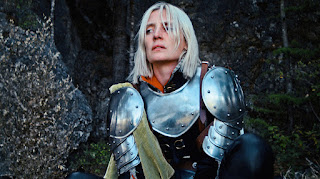
Like Dumont, Rivette took a tilt at the Joan of Arc story, and while his two-part epic Joan the Maid's influence can be seen in Schmitz's film, it is actually Rivette's more overtly theatre-centric works such as L'Amour fou and Va savoir that inform Lucie Loses Her Horse's exploration of the slippery relationship between theatre and cinema. Even the title of Schmitz's film is positively Rivettian, although if you waited around three hours to see Celine and Julie Go Boating's title characters finally jump in a vessel and take to the water, rest assured that Lucie (Lucie Debay, terrific) and her equine companion are parted in the early stages of Schmitz's sly, playful work. Upon losing her not so trusty steed, Lucie—kitted out in a fine suit of armour—promptly begins searching for the animal, in the process encountering two other female knights (Hélène Bressiant, Judith Williquet), both of whom have also managed to become separated from their horses. To lose one horse may be regarded as a misfortune, etc... actually, that quote doesn't quite fit this scenario—but hopefully you get the idea.
This medieval-themed episode comes wedged between two very different sequences: in the prior one, we witness Lucie the actress saying goodbye to her young daughter (Nao Wielemans-Debay) before she heads off to work; in the second, Lucie and the other two horseless knights—who, as it turns out, are fellow actresses—wake up in a theatre in which they're playing in a production of Shakespeare's King Lear. In case you don't count this as sufficiently meta, consider that Lucie's child is played by Lucie Debay's real-life daughter (Debay's partner is musician Antoine Wielemans, of Belgian indie act Girls in Hawaii), and also that Lucie Loses Her Horse morphed out of one of Schmitz's theatrical productions, Un Royaume, whose performances were truncated on account of the coronavirus pandemic. That one of the film's production companies is Le Théâtre de Liège, who staged the play on which the film is partly based, demonstrates how blurred the lines have become between the two works (and, by extension, the two media).
Before we get to thinking of where the MacGuffin that is Lucie's horse may have wandered off to, is it at all possible to establish which if any of these incarnations is the real Lucie? Is all the knights and horses stuff part of a fugue state, or simply another performance by the actresses? And does it really matter? Much of the film focuses on the increasingly chaotic backstage drama that unfolds at the theatre, most of which is fairly inconsequential yet oddly compelling. What we have here is essentially a shaggy dog story, one which remains completely absorbing should you allow yourself to go along with the joke. With Lucie Loses Her Horse, Claude Schmitz has planted one foot firmly in cinema and the other in theatre, resulting in both a deeply strange hybrid work and an alluring twilight world; it's a film as mischievous as it is haunting, and one strongly suspects that the late M. Rivette—Saturday past marked the sixth anniversary of his death—would have greatly enjoyed this unique meditation on theatre and cinema.
Believe it or not, half a century has now passed since the release of Dutch director Paul Verhoeven's first feature film, Wat zien ik!? (aka Business is Business). In the years since, Verhoeven has shocked audiences both in Europe (Spetters, De vierde man) and across the pond (Robocop, Basic Instinct), all the while cementing a formidable reputation as an enfant terrible with major box-office clout. As time has gone on, Verhoeven has slowed down—perhaps understandably, given that he's now 83 years old—and significant gaps have appeared between his projects; the Dutch-language Zwartboek was his first film in six years, and a full decade would pass between its 2006 release and his return to cinemas with Elle. While his new film, Benedetta, has appeared a mere five years on from Elle, you do wonder when Verhoeven might decide to call it a day. It will be a pity when he does as, ever since the mid-1980s, the release of a new Paul Verhoeven film has always been something of an event, and neither his reduced output nor his return to Europe from Hollywood—it is now over 20 years since his last English-language effort, Hollow Man—has impacted on the anticipation that precedes a new Verhoeven movie.
Benedetta premiered in competition for the Palme d'Or at this year's Cannes Film Festival, and while it didn't win—Titane, which will be reviewed here shortly, scooped the main prize—the film nonetheless enjoyed a high-profile outing at the first post-COVID edition of the festival. As is almost always the case with Verhoeven's films, Benedetta is a work that sets out to ruffle more than a few feathers, yet it falls some way short of the transgressiveness of many of the director's prior films, including its immediate predecessor, the enjoyably trashy Elle. The success of the controversial, highly successful Elle owed much to the committed performance of Isabelle Huppert, who received an Oscar nomination for her electrifying turn; I fully expected Huppert to turn up in Benedetta, and I can only speculate that the role filled by the excellent Charlotte Rampling was originally penned with Huppert in mind. Given that Huppert played a similar part in Guillaume Nicloux's 2013 adaptation of Diderot's The Nun, perhaps it wouldn't have been the best idea for her to be cast here, if indeed she was offered the role; plus, it's always good to see Rampling at work.
Benedetta is adapted from Judith Brown's book Immodest Acts, and the title character is played one of Isabelle Huppert's Elle co-stars: the terrific Belgian actress Virginie Efira, who can consider herself very unlucky not to have been among the winners when Albert Dupontel's superb Bye Bye Morons netted a glut of César awards earlier this year. In Benedetta, Efira's nun has been in a convent since the age of eight, and during her time there she's claimed to have been on the business end of several miraculous happenings—such as visions of Jesus and the acquisition of stigmata. All of this is viewed with some scepticism by Rampling's stern abbess, whose demeanour grows yet more severe upon the arrival of a new charge in the form of Bartolomea (Efira's fellow Belgian Daphné Patakia), a rebellious type who wastes little time in entering into a romantic relationship with Benedetta. On Bartolomea's frantic introduction—she's trying to escape her abusive family—the abbess points out that the convent isn't a charity, and asks the desperate girl if she has money; this frank discussion brilliantly illustrates how quick God's earthly ambassadors can be to move the goalposts when the time comes to help those in need. 1-0 to Verhoeven.
With Benedetta, Paul Verhoeven has set out his stall somewhere between Jacques Rivette's stately La Religieuse and Ken Russell's scabrous The Devils, yet the end product serves up neither the emotional point of the former nor the biting critique of the latter; furthermore, Verhoeven's film doesn't give the viewer much of an opportunity to invest in its characters, despite the sterling efforts of both Efira and Rampling. And in spite of its best efforts to offend, Benedetta feels an oddly tame, muted affair—compared to 30 years ago, the bar has been raised considerably vis-à-vis what is considered to be outré, and Verhoeven is doing little more than treading water here as he rifles through the index cards of his past successes; in all honesty, it's quite disappointing to discover that this director's attempt at nunsploitation has resulted in one of the subgenre's milder entries. It all feels a bit reheated, and the casting of Lambert Wilson and Olivier Rabourdin only serves to recall their work in Of Gods and Men—a much more affecting tale of monastic life. Still, for all that, Benedetta generally works as lurid, pulpy fun, which is pretty much what we all want and expect from a Paul Verhoeven film. You won't change him now.
OSS 117 director Michel Hazanavicius won an Oscar in 2012 for The Artist, his charming (if slight) silent movie which netted four other Academy Awards, including one for OSS star Jean Dujardin. Hazanavicius faltered with his next film, a poorly-received remake of Fred Zinneman's The Search, but bounced back in 2017 with the excellent Jean-Luc Godard biopic Redoubtable. Happily, his latest film provides further proof that The Search was little more than a blip. As with the majority of his work, The Lost Prince stars Hazanavicius' wife Bérénice Bejo, who is here joined by Omar Sy, an actor who in recent years has landed a string of roles in entries in long-running Hollywood franchises such as Jurassic Park, X-Men and Transformers. There's also a sizeable part for Belgian star François Damiens, who brings his fine sense of comic timing to what can perhaps be best described as a fairy tale with a rather unique twist.
Djibi (Sy) is a single dad who is completely devoted to his young daughter Sofia (Sarah Gaye). Every night, Djibi settles down with Sofia and reads her a bedtime story, and it is during these tales that the father enters a Day-Glo fantasy world in which his words really do come to life. In this realm, Djibi is a prince, one who always comes to Sofia's rescue when the wicked Pritprout (Damiens) has executed some dastardly plan or other. But although Djibi's prince always saves the day, it does seem that he is aware this is just a role: once a story's finished, the main characters are revealed to be played by actors, and we witness the crew and all the backstage efforts that go into mounting these elaborate scenarios. All of this is in sharp contrast to the modest reality occupied by Sofia and Djibi, who live in a small but cosy flat where they soon gain a new neighbour in the form of the chatty, likeable Clotilde (Bejo), who will soon appear in both worlds.
While Djibi seems quite happy with the status quo, he fails to catch on to the fact that Sofia is growing up fast, and once she gets to high school she discovers other things in her life, meaning she would like her evenings to consist of a bit more than Djibi's stories. Among these other interests is Max (Néotis Ronzon), a friendly classmate who is one of the first to befriend the 12-year-old at her new school. As Djibi continues to make forays into the fantasy world, he soon discovers that he's no longer the star of the show, having been usurped by a much younger prince. Joining the dots between the events of the two worlds isn't exactly difficult, and Djibi - who's now been relegated to little more than a bit player - plots to restore things to how they were. In the fictional universe, Djibi is aided in his quest by an unlikely ally in the shape of former nemesis Pritprout, while in the real world it is down to Clotilde to provide some much-needed perspective.
The Lost Prince proves to be a more satisfying film than the somewhat overrated The Artist, and it's a warm if rather predictable tale which features typically winning performances from Sy, Bejo and Damiens. The scenes set in the fantasy world look incredible, with Hazanavicius' regular cinematographer Guillaume Schiffman turning in some sterling work here. The film features a nice nod to Schiffman's mother Suzanne in the form of a glimpse of a bus stop which bears her name; Schiffman Sr. worked closely with Truffaut, Godard and Rivette, among other greats, and it's often overlooked that she was the co-director (with Rivette) of the 13-hour Out 1. The Lost Prince was certainly not a cheap film to make, so it's something of a pity that it appears to be set for middling box-office returns; it's a well-crafted slice of family entertainment, one which shows a bit more ambition than most films of its ilk. While his two OSS 117 films remain this director's best work (a third instalment has just finished filming - without Hazanavicius - and is set for release next year), The Lost Prince is certainly a worthy addition to his CV.
Following the second series of Li'l Quinquin, Bruno Dumont immediately set about making another sequel with Jeanne, or Joan of Arc, which continues his retelling of the Maid of Orléans' story which began with 2017's demented musical Jeannette: The Childhood of Joan of Arc (which, incidentally, was the very first film to be reviewed in this incarnation of Holland Focus). As with its predecessor, Jeanne is an adaptation of Charles Péguy's 1897 play Jeanne d'Arc, but this time around Dumont mixes it up a bit and opts for much gentler musical accompaniment in the form of the variété française of 70s pop star Christophe (who cameos here), whose distinctive falsetto replaces the much harsher sounds of Jeannette composer Igorrr. There's another key personnel change in the form of cinematographer David Chambille, who comes in for Dumont's longtime DP Guillaume Deffontaines. Chambille, who lensed last year's smash hit Invisibles, steps into Deffontaines' shoes without missing a beat, and his work here on the interiors (of which there were none in Jeannette) proves to be particularly impressive.
But perhaps the biggest surprise in Jeanne - which earned a Special Mention from the jury at Cannes - comes in the form of the casting of its leading actress. While you may have been expecting to see Jeanne Voisin continue in the role she played in the second half of the earlier film, it's Lise Leplat Prudhomme - the younger Joan in the previous instalment - who returns from Jeannette to play a much older version of the character in Jeanne. Apparently Voisin was lined up to play the part but eventually bowed out, leaving Dumont to turn to his other Joan from Jeannette. As a result, watching the two works as a double bill (or simply one very long film) will no doubt be rather jarring in terms of continuity - Joan will apparently get older then younger, perhaps leading viewers to think that Jeanne Voisin's scenes are some sort of flash-forward. But any such issues shouldn't detract from the work of Prudhomme, who gives another terrific performance here, despite playing a character who, by the end of the film, is nearly twice the actress' age. Jeanne is a long, hefty and frequently taxing film, and this talented ten-year-old carries it quite brilliantly.
Jeanne begins with things going very well for the title character as the Hundred Years' War between France and England rages on; with her famous victory at the Battle of Orléans in the bag, Joan is delighted to see the Dauphin crowned king of France. However, after Charles VII (Fabrice Luchini) is installed as monarch (thanks in no small part to Joan's help), he takes a position very different to that of Joan regarding how events should proceed: Charles favours diplomacy, while La Pucelle wishes to continue fighting. As Joan's military luck eventually runs out, she's captured then delivered to the English, for whom she's proved to be quite the fly in the ointment. The rest - indeed, the bulk - of the film is dedicated to the exhaustive, and exhausting, ecclesiastical interrogation which this young woman is subjected to in Rouen (actually Amiens) Cathedral. Needless to say, King Charles is nowhere to be seen as Joan is tried and sentenced. Unless you've been living under a rock, you'll be painfully aware of the horrible, fiery fate which awaits the protagonist, and in Jeanne - as in every other screen version of this story - her inevitable untimely death hangs over the entire duration as events stick to their terrible course.
Movies about Joan of Arc are nearly as old as cinema itself and, of the many films of Joan's story, the one Dumont's take has most in common with is Jacques Rivette's Joan the Maid - although the parallels are only fully obvious now Dumont has made this second film. Rivette's version likewise cast an actress whose age (27) was some way off that of the real Joan, and was also released as two separate films (carrying the sub-titles The Battles and The Prisons), each of which documented a different stage of Joan's short life. Equally perversely, both projects disregard significant events: Jeanne neglects to show the capture of Joan by the Burgundians, while Joan the Maid - which totals a running time of well over five hours in its unexpurgated version - omits her entire trial, slapping up a solitary title card to account for months of what Jeanne depicts. And Dumont, just like Rivette before him and no doubt for similar (i.e. budgetary) reasons, populates his Joan of Arc films with just a few characters at any given time; those coming to any of these films expecting to see hundreds of extras battling it out, Lord of the Rings-style, at Orlèans or Compiègne will be sorely disappointed, and may be better served by Luc Besson's unfairly maligned The Messenger.
While such a constraint could easily have seen all four of the Rivette/Dumont films succumb to an unwelcome staginess (not that Rivette was averse to a bit of theatricality in many of his other films), in Dumont's case this has been resolved via some huge, wide shots of both the windswept Opal Coast and the interior of Amiens Cathedral; both directors' films on Joan - which share a distributor in Les Films du Losange - certainly feel grand (Rivette also used the landscape to let his film open up and breathe). In Jeanne it's actually the cathedral scenes which are the more effective, as the exteriors feature a number of abandoned WW2 blockhouses - one of which serves as Joan's prison - which are far too recognisably 20th century to really aid suspension of disbelief. While these buildings make for an atmospheric backdrop to some of the scenes in the quite contemporary Li'l Quinquin, their presence in Jeanne is most distracting - even if Dumont claims to be aiming for a "timeless" accuracy, as opposed to a historical one. Of course, if you're not familiar with the area where Jeanne was filmed, then this may not present too much of a problem.
In many ways, the main purpose of Jeanne appears to be to replicate the gruelling nature of Joan's trial - that is to say, to make the audience feel as drained, weary and bewildered as our young heroine as she endures endless rounds of arcane questions from the parade of clerics that lines the cathedral's benches. The clergy's attempts may be futile vis-à-vis wearing down the accused, but they prove to be quite effective when it comes to getting the viewer to crack: the screening I attended saw numerous walkouts - apparently a not uncommon occurrence during Jeanne's theatrical release (and festival showings). It's certainly an endurance test, and if the dry theological debates don't get you, chances are the long static takes will. In employing such a daring, unusual film grammar, Dumont has created what is by far his most challenging work; not only is the pacing very slow and deliberate, but at 138 minutes this is the second longest of the director's films (1999's Humanity - which positively flies by in comparison - exceeds it by around ten minutes). Jeannette may have been niche, but its sequel will appeal to far, far fewer. Which is not to say that the film isn't worthwhile; here, Bruno Dumont presents a real cinema experience in which those with sufficient patience (say, of a saint?) will be rewarded - although the austere Jeanne has no intention of giving up its mysteries without a fight. You have been warned.
Jeannette, l'enfance de Jeanne d'Arc (English: Jeannette: The Childhood of Joan of Arc), which screened at this year's Cannes, has had a rather atypical release in that it debuted on French television one week before appearing in cinemas. Word has it that the TV and cinema versions do differ a little, but the fact that most could watch the film for free has obviously impacted on the domestic theatrical release: it would appear that a lone print is touring Paris' MK2 cinemas during the first week, while screenings in cities including Lille, Dunkerque and Amiens - all firmly within director Bruno Dumont's native Nord-Pas-de-Calais - are also taking place.
Set during the Hundred Years' War, Jeannette's story is adequately described by its full title, as we witness Joan of Arc first as a young girl, then a teenager, before finally heading off to battle - basically, it ends at the point where virtually all other films about the Maid of Orleans begin. Plot-wise, there isn't much else to say, and the bulk of the film sees Joan among her sheep in the sand dunes (of Wissant, where Dumont's Ma Loute was also shot) as she gradually gets to grips with her calling. What the title doesn't tell you is that this is a musical, although one that most definitely doesn't carry the broad appeal of La La Land. The film is based on two works by Charles Péguy, and his turn of the century writing comes to life as lyrics set to the music of electronicore artist Igorrr. Refreshingly, the vocals were recorded live on set, as opposed to the usual process of lip-syncing to playback. This makes the two lead performances all the more remarkable, plus it lends the type of authentic immediacy we've long since associated with this director.
The title character is played by two actresses, who, looks-wise, are a good fit for each other. Lise Leplat Prudhomme takes on the role of the 8-year-old Joan, and the teenaged version is essayed by Jeanne Voisin; the younger Joan is known as the Jeannette of the title, whereas the diminutive suffix is dropped by the time the future saint hits double figures. Each actress gets an equal share of screen time, with the film pretty much split down the middle as it depicts these two stages of Joan's life. While it's easy to simply think that Dumont's film is about the young Joan of Arc, it's rather poignant to consider that she was actually never anything other than young, given that she perished at the stake just a few short years after the events shown in this film. Most biopics focusing on a subject's youth tend to show someone who went on to have a reasonably full life, or at least made it beyond their teens, whereas the childhood depicted here comprised the bulk of Joan's existence.
Jeannette is yet another good example of Dumont turning up unknowns who give truly captivating performances. His major find here is highlighted within the film's first few minutes as Prudhomme, in a bravura sequence, sings and dances her way through an extended number among the dunes. It's an engrossing, amusing and oddly moving opening, and the young actress greatly impresses in the time (nearly an hour) in which she's on screen. By the time it gets to Voisin's chance to shine, the novelty factor is slightly diminished - the older actress is, somewhat unsurprisingly, a slicker performer, and the raw appeal of her predecessor is notably absent. But Voisin is very watchable, too - scenes with her and a rapping Ch'ti uncle (Nicolas Leclaire, the most typically Dumontian member of the cast) make for the film's comic highlights - and we should remember it's not her fault she's on second.
Watching the performers here is a reminder that Dumont works better in full-on Bresson mode, i.e. when he casts non-professionals - while Camille Claudel 1915 and, to a lesser extent, Ma Loute both showed that he can operate perfectly well when accommodating big stars, it's the unfiltered, direct essence that Dumont is able to draw from largely untutored performers that gives his work a unique edge. DP Guillaume Deffontaines, in his fourth collaboration with Dumont, expertly captures the windswept vistas of this part of the Pas-de-Calais, and his camerawork is always inventive (although never intrusive), which is especially important given that most of the film takes place in a single location.
Dumont's films are not for all tastes, so if you're familiar with his previous work chances are you'll know if this film is for you. Anyone who's studied his career will note how, post-Camille Claudel 1915, he's taken something of a left turn and planted one foot (perhaps just one toe?) in comedy: P'tit Quinquin - series 2 of which is due next year - was a semi-humorous retread of his earlier L'humanité, while Ma Loute took the same basic template and cranked up the broad comic elements. Jeannette manages to be humorous (can any film featuring headbanging nuns really be anything else?) yet sincere, and at no point does Dumont appear to be mocking his subject or her beliefs. The film's closing shot is really quite affecting when you consider the fate that soon awaits the unknowing Joan. Go from this to Jacques Rivette's Jeanne la Pucelle and you'll have quite a double (or should that be triple?) bill.