Wednesday, 25 May 2022
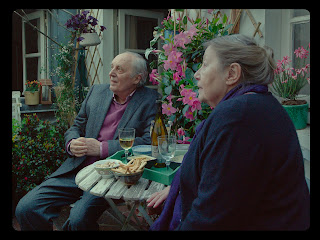
Vortex (Gaspar Noé, 2021)
Tuesday, 2 February 2021
Lux Æterna (Gaspar Noé, 2019)
Amazingly, the last Cannes Film Festival took place way back in 2019, and it was during this edition that Gaspar Noé's Lux Æterna was first unleashed; in September 2020, during a welcome if brief window in which cinemas were permitted to reopen, the film received a theatrical release in France. For those of us who didn't manage to catch the film on the big screen, it's been an extremely long wait, but last month Lux Æterna began to surface on several VOD platforms; while consuming the film in this manner isn't exactly ideal, your eyeballs will probably thank you by the time you reach the end of the mild-mannered Noé's latest visual assault on audiences. In all seriousness, Lux Æterna is a film that fully warrants its epilepsy warning, so please keep this in mind before viewing. When the film received its French premiere, it was preceded by a Noé short titled The Art of Filmmaking, a stroboscopic essay film that is borderline unwatchable, and I do wonder what condition the audience were in when they braced themselves for the main feature.
Yet to refer to Lux Æterna as a feature is slightly misleading, as it runs to a little over fifty minutes. Noé initially received funding from Saint Laurent to shoot an advert for the luxury fashion house, but came up with something that was much longer than, and some way from, what was ordered; luckily, YSL were very happy with what their money had been spent on. Noé actually shot enough footage to make a feature film of typical length, but Lux Æterna's liberal use of split-screen effectively halves the film's runtime. As such, the film is closer in length to Noé's uncompromising Carne - a work that's now a full thirty years old - than it is to any of his five full-length films from I Stand Alone through Climax. While the addition of The Art of Filmmaking would have allowed the programme to be classified as a feature film in France, the short isn't included in the version currently streaming, so we are best to consider Lux Æterna to be a medium-length work, albeit one that proves to be way more interesting than many films twice the length. While its fierce strobe effects prove to be something of an endurance test, Lux Æterna stands as Noé's tamest film (it's all relative), as it eschews both the juddering violence and sexually explicit material we've largely come to expect from his work.
As with every Noé film from 2002's Irreversible on, Lux Æterna features the work of expert cinematographer Benoit Debie, and the brilliant Belgian's work here provides yet further proof of both his extraordinary ability and the essential part he plays in forming Noé's now-trademark aesthetic. Lux Æterna, like Irreversible - which was recently re-edited into a chronological version that is now available on Blu-ray - culminates in a sensory overload, but at least this time around the audience doesn't face the challenge while still fresh from a pummelling by two of the most brutal sequences in modern mainstream cinema; Lux Æterna, despite instilling the rising sense of unease we've long since come to associate with Noé's films, is at its heart a warm, rather playful affair, one in which all of the cast and crew are credited by just their first names, which stands in sharp contrast to Irreversible's opening (closing?) credits, wherein those on both sides of the camera were coldly, simply denoted by their surnames.
Lux Æterna is a meta-movie in which actresses Charlotte Gainsbourg and Béatrice Dalle play themselves; Dalle is directing a film about witch trials, and Gainsbourg is the star. Yet Dalle is faced with many obstacles, ranging from meddling producers to a highly subversive cinematographer, plus there's Karl Glusman, from Noé's 3D movie Love, as a rather desperate type who's apparently flown in from LA just to pitch his new project to the put-upon Gainsbourg. For the climactic witch-burning scene of Dalle's film, models Abbey Lee and Mica Argañaraz flank Gainsbourg as the three are tied to stakes in front of a green screen. But a strange lighting glitch occurs, and Lux Æterna winds to its fiery conclusion via a full-bore RGB nightmare. These closing moments are really the film's raison d'être, and they deliver exactly what we've come to expect from Noé, which is a real experience; he's a filmmaker who's always determined to evoke a visceral response from his audience. While Noé always appears chiefly interested in what his viewers think - or, more accurately, feel - when they're caught up in watching his work, his prior films are all extremely memorable, and the infernal, invigorating Lux Æterna, in which Noé delivers his thrills with typical aplomb, is thankfully no different.
Darren Arnold
Images: UFO Distribution
Friday, 12 April 2019
The Sisters Brothers (Jacques Audiard, 2018)
It can often be rather worrying when an established director makes a film in a foreign language for the first time, but the stakes seem especially high when the filmmaker in question is arguably the greatest director working today. It's fair to say that Jacques Audiard's stunning run from Read My Lips through Dheepan has cemented his place as one of the true greats - a director who rarely seems to put a foot out of place. Audiard had much to risk by stepping out of his comfort zone to make a film in English; his prior work was always highly nuanced, and filmmakers working in another tongue can often pass over the subtleties of that language. Happily - and possibly surprisingly - Audiard comes up trumps with The Sisters Brothers, a terrific western that can proudly sit alongside his other works such as Rust and Bone and A Prophet. The film's quality is evident from the off, and any doubts we may have had are quickly extinguished.
Set in the unforgiving Oregon of the 1850s, the film follows hitmen brothers Charlie and Eli (Joaquin Phoenix, John C. Reilly) as they carry out the bidding of a wealthy Commodore (Rutger Hauer). As gunfighters, the brothers prove to be as good as anyone around, and even when the pair are outnumbered, they're never outgunned. Eli is the more sensitive of the two, while Charlie regularly drowns his own demons in alcohol, which often leaves him in no condition to ride - although it seems that little can blunt his fighting skills. The Commodore sends the two to hunt down Warm (Riz Ahmed), a timid and sickly-looking gent on his way to California with the Gold Rush. Taking no chances, the Commodore has also hired Morris (Jake Gyllenhaal), a private detective who locates and befriends Warm; Morris grows uneasy at the thought of the grisly end which awaits Warm when the Sisters catch up him, and he and the would-be prospector set out for California together. With this complication in place, the Sisters find themselves on the trail of both Warm and Morris.
When the two parties eventually come face to face, Audiard brilliantly wrong-foots us and the story takes an unexpected turn. To detail it here would be to say a little too much, but suffice to say that Warm has been working on a formula for locating gold, and this becomes central to the fates of all four men. This development comes as part of a whole which feels at once fresh and familiar; Audiard and his trusted co-writer Thomas Bidegain, not for the first time, have created a world in which there's a perfect balance of light and shade. It is fair to say that the way you view each of the four main characters will change - probably more than once - over the course of the film's running time. All of this is captured magnificently by the great Belgian cinematographer Benoit Debîe, who recently lensed Gaspar Noé's Climax; Debie makes a major contribution when it comes to putting us in the thick of lawless, dusty 19th century America (although the film was actually shot in Spain). There are few cinematographers whose work is worth viewing regardless of the director they're teamed with, but Debie's sterling efforts are always worth seeking out; all the better when he links up with the likes of Noé and Audiard.
The Sisters Brothers is adapted from a novel by Canadian author Patrick deWitt, who wrote the screenplay for Terri, which coincidentally also starred John C. Reilly - who's on double duty for The Sisters Brothers, with the actor also taking on the role of producer (alongside Jean-Pierre and Luc Dardenne, no less). You can see the appeal of the story to Audiard: criminals feature prominently in all of his films (bar A Self-Made Hero), and the same concerns are prevalent here - even if the milieu marks new territory for the director. A recurrent theme in Audiard's work - of the man who tries to turn away from a life of crime - is also present in The Sisters Brothers. So, the essence of the film actually isn't so different from what we have come to expect from Jacques Audiard, even if the packaging is unfamiliar. What is noticeably different this time around is that Audiard pushes more characters to the forefront; usually, his films focus almost exclusively on one or two people, but here he manages to spread the load among the four main characters and, remarkably, they are all equally fascinating. As such, it's something of an ensemble piece, one which features a quartet of actors on top form. Whether Audiard ventures into English-language filmmaking again remains to be seen, but what isn't in any doubt is that The Sisters Brothers is a must-see film of tremendous quality.
Darren Arnold
Images: UniFrance
Thursday, 28 February 2019
Climax (Gaspar Noé, 2018)
Following these exertions, it's time for a party to mark the end of the intensive rehearsal period. The dancers break off into couples, and we get to eavesdrop on the various conversations, which almost invariably involve bitching about other members of the troupe. Noé breaks from his one-take approach here, and dips in and out of the different discussions in a fidgety manner. None of the dialogue is particularly consequential, but it does give each of the characters a little more room to establish their personalities (prior to this, we've just seen fragments of recorded interviews with each member). After this pause for breath, there's another exciting, prolonged dance sequence, this time focusing on the dancers' individual talents; as before, Noé chronicles this with an unblinking eye, although this time around it's from an overhead vantage point. And then, most surprisingly, another set of credits appears - which serves as a line dividing the film's two very different parts. Noé's debut feature, I Stand Alone, contained an on-screen warning which gave you 30 seconds to abandon the cinema before the film really plummeted into the cesspool. Climax's mid-film credits could be similarly viewed as a warning, albeit of the coded variety - after all, don't we normally leave once the second lot of credits roll? Indeed, one person at the screening I attended adhered to this protocol.