Showing posts with label Swann Arlaud. Show all posts

Sunday, 1 February 2026

The Stranger (François Ozon, 2025)

An image from the film The Stranger. A man is standing on a sandy beach next to a wooden structure.

The Stranger is the prolific François Ozon's 24th feature film—an impressive figure, given that his first full-length movie, the queasy Sitcom, was released just 27 years ago.  Ozon's next feature but one after Sitcom, the slightly less transgressive Water Drops on Burning Rocks, was an adaptation of a play by Bavarian bad boy Rainer Werner Fassbinder—a director who churned out films at a rate that makes Ozon look like Stanley Kubrick.  For his latest feature, Ozon again goes down the road of the literary adaptation, with The Stranger seeing the versatile filmmaker tackle an undisputed classic in the form of Albert Camus' eponymous 1942 novella, which was the first of its revered author's works to be published.


While Ozon has had some success adapting books by writers as varied as Joyce Carol Oates (Double Lover), Ruth Rendell (The New Girlfriend), Aidan Chambers (Summer of 85), and Elizabeth Taylor (Angel), there is the sense here that Ozon has set himself a stiffer challenge as he grapples with the murky existential abyss at the centre of Camus' most famous work.  Happily, Ozon's film of The Stranger is both a resounding success and one of its director's finest achievements.  The Stranger is one of several Ozon features to have been shot by the Belgian cinematographer Manu Dacosse, whose other recent work includes Fabrice du Welz's Maldoror and Hélène Cattet and Bruno Forzani's Reflection in a Dead Diamond.


After Maldoror's rather muted colour palette and Reflection in a Dead Diamond's kaleidoscopic visuals, The Stranger sees Dacosse shooting in crisp black and white—and it seems almost inconceivable that this tale, set in sun-drenched French Algeria, could be presented any other way.  For the main character, Meursault (Benjamin Voisin), is a man drained of all colour, and his indifference to life (and death) leads him to kill an unnamed Arab man.  While his girlfriend Marie (Rebecca Marder) hopes for no worse than a light custodial sentence, Meursault's reaction could be viewed as the ultimate Gallic shrug.  At his trial, he makes little effort to explain the mitigating circumstances that led to his actions.


Late in the film, Swann Arlaud appears as a priest who visits Meursault in his cell.  The prisoner’s nihilistic response to the clergyman’s pleas is all too predictable—but still fascinating.  Yet there’s something slightly off about the scene; it leaves the film feeling a little unbalanced, as though it exists largely to accommodate Arlaud—one of the finest actors of his generation.  One wonders whether a lesser-known performer might have served the film better, with the sequence shortened.  Still, this is of little consequence when the performances are this good.  The Stranger remains a riveting film and a rigorous adaptation—one that sees Ozon cut cleanly to the dark heart of Camus’ knotty, evasive text.

Darren Arnold


Saturday, 19 March 2022

I Want to Talk About Duras (Claire Simon, 2021)


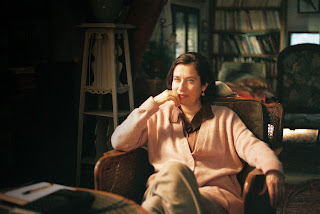
The renowned writer Marguerite Duras enjoyed both a successful career and a highly eventful personal life, and it is the latter that forms the focus of Claire Simon's I Want to Talk About Duras.  Simon's new film is not concerned with the author's teenage escapades in Indochina—that much-publicised period was covered in Jean-Jacques Annaud's eponymous screen adaptation of Duras' The Lover—but rather examines the relationship between the writer and youthful Breton Yann Andréa, a Duras überfan who, after many years of correspondence, found himself in the rather surreal position of sharing a home and bed with his idol.  There was an age gap of nearly half a century between Andréa and Duras, both of whom are now deceased, and their unlikely union could be compared to the one experienced by the title characters in Hal Ashby's Harold and Maude.  Simon's film, which screens as part of this year's BFI Flare on March 20 and 22, concentrates on Andréa's 1982 interviews with Marie Claire journalist Michèle Manceaux, during which the subject spoke candidly about his then-ongoing relationship with Duras.  


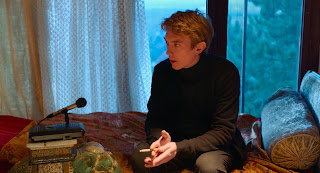
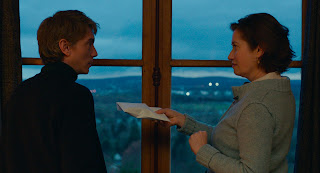
I Want to Talk About Duras isn't the first film on this subject: 2001's Cet amour-là, which starred the legendary Jeanne Moreau as Duras, also set about telling this most atypical of stories; coincidentally, Moreau served as the narrator for The Lover.  I Want to Talk About Duras differs from Cet amour-là in a key sense: Duras herself is largely absent from Simon's film, although the author does appear via archive footage that underlines some of the points being made in the interviews.  Instead of focusing directly on the author, I Want to Talk About Duras places Swann Arlaud's Andréa and Emmanuelle Devos' Manceaux front and centre, although Duras' presence is still keenly felt; not only is the writer the main topic of discussion, but we can hear her clumping around on another floor of the home she shares with Andréa.  What's more, she frequently resorts to a disruptive tactic in the form of calling the telephone which sits just next to her partner.  As such, Duras is a ghostly, unnerving presence, one who always seems to be hovering around the edges of the action.


For a film centring on Marguerite Duras to relegate the title character to the periphery seems rather perverse—doubly so when it stars the incomparable Emmanuelle Devos, whose casting here tantalisingly hints at what she could have done if handed the role of Duras (anyone who doubts Devos' suitability for such a part need look no further than her terrific turn as Violette Leduc—another author who was no stranger to scandal—in Martin Provost's excellent biopic Violette).  It is to Simon's great credit that I Want to Talk About Duras survives both this daring move and the equally bold stroke of splicing in a sequence from Duras' 1975 film India Song, which practically invites the viewer to think about which film they'd rather be watching.  Devos' Michèle Manceaux doesn't have to say a great deal while her tape recorder absorbs Andréa's thoughts on Duras, but there are numerous occasions when the camera remains fixed on her face as she listens intently; Simon clearly understands how best to use Devos' wonderfully expressive features.  


Much of what Andréa has to say conjures up a most unflattering picture of Duras, who is painted as a domineering control freak, one who dictates virtually everything in the relationship, ranging from Yann's diet to his sexuality.  It's a disturbing arrangement, yet one in which Andréa seems to have found some sort of contentment—even if he fails to truly comprehend the setup's unwholesome nature.  With this film, Simon has set herself several stiff challenges—in this sense, it recalls Lars von Trier and Jørgen Leth's The Five Obstructions—but what is perhaps the biggest potential pitfall of all comes in the form of the film being a two-hander, a format which may be fine for the stage yet often founders in the far less forgiving medium of cinema.  Simon sidesteps this by opening the film up whenever a flicker of staginess threatens to creep in; in addition to the aforementioned extract from India Song, there's a mesmerising crepuscular scene detailing Mancieux's walk home after a long day of interviewing.  Of course, much can be overlooked in a film starring these two fine actors, and Swann Arlaud exudes the same sort of sensitive fragility he channelled so effectively in François Ozon's outstanding By the Grace of God.  Despite the myriad obstacles Claire Simon places in her own path, I Want to Talk About Duras is an engaging, invigorating work.

Darren Arnold

Images: BFI

Thursday, 21 November 2019

By the Grace of God (François Ozon, 2019)


François Ozon is a filmmaker who almost always comes up with something interesting.  Some of his earlier works were associated with the New French Extremity, and for many years this prolific, mischievous director has seesawed between high frivolity (8 Women, Potiche) and more sombre concerns (5x2, Time to Leave).  While sitting down to watch an Ozon film, you're pretty confident you'll find him working in one of these modes - or maybe even both, as in In the House and Young & Beautiful.  His most recent film prior to By the Grace of God was Double Lover, which played almost as a self-parody: borderline transgressive, trashy and sloppy, it was a film which saw Ozon treading water as he went through the motions of adapting Joyce Carol Oates' 1987 novel Lives of the Twins.  While admittedly rather fun, it was cookie-cutter Ozon which presented nothing especially new.  But the throwaway Double Lover provided no hint as to what Ozon would do next: his latest film is a truly staggering work, one quite unlike anything else in the director's filmography.


As with the terrific Oscar-winner Spotlight, By the Grace of God is concerned with the Catholic Church abuse scandal, and Ozon is quite open about the similarities between the two films.  However, By the Grace of God does differ from Tom McCarthy's movie, not least in that Ozon's film was made as the trial of one of its characters was still in progress; an unusual move, certainly, yet one which imbues the film with a sense of freshness and immediacy which is almost palpable.  By the Grace of God was not only made while these court proceedings were underway, but the film itself was dragged into the courts as Bernard Preynat, the priest depicted in the film, attempted to block its release.  Incredibly, this €6 million production was only cleared for release the day before it was due to hit cinemas.  Indeed, the story of By the Grace of God's production would make for a gripping film in itself.

Ozon's film follows three grown men, all of whom were childhood victims of Preynat (Bernard Verley).  The first chunk of the film is devoted to Alexandre (Ozon regular Melvil Poupaud), a calm family man who's shocked to learn that Preynat, under the Cardinal's protection, is still working with children.  As a result of this discovery, Alexandre decides to take action, and a church psychologist arranges a meeting between victim and abuser, which is intended to aid the healing process.  Preynat doesn't deny what happened, and while he seems pleased to see that Alexandre has grown up to be a well-adjusted member of society, the priest doesn't seem especially sorry for the crimes he committed, merely stating that they were the symptom of an illness; he's certainly not looking for forgiveness.  The slightly surreal meeting ends with the truly sickening, horrifying sight of Alexandre being persuaded to take Preynat's hand as a concluding prayer is recited.


The more cautious Alexandre then gives way in the narrative to the headstrong François (Denis Ménochet), another victim, yet one who wants to cause maximum damage to the Church.  Like Alexandre, François has grown up to become a content and fulfilled adult, yet his atheism drives him in a way which Alexandre - who still attends church with his young family - can't fully relate to.  Nonetheless, Alexandre and François have more than enough in common as they look to take on Cardinal Barbarin (François Marthouret), who seems chiefly concerned with putting his institution's reputation ahead of its victims.  The film's title comes from a quote from the Cardinal, who stated that it was "by the grace of God" that the statute of limitations precluded most of the abuse cases making it to court.  Make of that what you will.

Emmanuel (Swann Arlaud), the third and last of the film's main characters to be introduced, is by far the most damaged of the Church's victims.  Prone to seizures which are linked to the trauma of his abuse, the unemployed Emmanuel appears to have spent his entire adult life on his uppers, and lives in a shabby apartment with a girlfriend he constantly argues with.  But through meeting Alexandre, François and other victims, Emmanuel gains a sense of purpose as this trio of very different men join forces in order to seek justice.  While the three main actors are all terrific here, it's Arlaud who steals the film with a truly incendiary performance, with his Emmanuel representing the impact of the Church's crimes at its worst: for every Alexandre (or François) who managed to get on with their life, there are many Emmanuels out there, stuck in a rut, broken and forgotten - if they're still alive.


By the Grace of God is an immaculate, quietly devastating work which continues telling a story the world needs to hear.  While someone might suggest you should just watch Spotlight instead as it covers a lot of similar ground, By the Grace of God's existence is hugely important, as it serves as a European angle on a problem which has affected many parts of the world; hopefully, there will be more films which highlight the Catholic Church abuse scandal in other territories.  While it may well be Ozon's best film, By the Grace of God is also the least typical of the director's works, and his fingerprints are nowhere to be found here; it provides final proof, if any were needed, of this genre-hopping filmmaker's versatility.  While normal service will most likely be resumed with his upcoming Eté 84 (which also stars Poupaud and has already finished shooting), this welcome departure for François Ozon is a vital, urgent work, and one of 2019's best films.

Darren Arnold

Images: image.net