Showing posts with label Lucie Debay. Show all posts

Thursday, 1 August 2024

You Promised Me the Sea (Nadir Moknèche, 2023)

An image from the film You Promised Me the Sea. A woman with short dark hair sits in a formal setting.

Nadir Moknèche's debut feature Le harem de Mme Osmane was released nearly 25 years ago, and the director followed that film with the Belgian co-production Viva Laldjérie, which played at the 2005 edition of IFF Rotterdam; since then, he's directed several solid features (Lola Pater, Goodbye Morocco, Délice Paloma) en route to his latest effort, You Promised Me the Sea (French: L'air de la mer rend libre).  Moknèche's new film was one of the selections for this year's BFI Flare, where it screened alongside several other strong examples of francophone cinema including Chloé Robichaud's Days of Happiness, Edith Chapin's Sex is Comedy: The Revolution of Intimacy Coordinators, Jérémy Piette's The Blue Shelter, and Paul B. Preciado's Orlando, My Political Biography.       


Moknèche's previous film, the aforementioned Lola Pater—which starred the legendary Fanny Ardant and featured a juicy role for the excellent Belgian actress Lucie Debay—hinged on a parent who'd long kept a secret from their adult son, and in You Promised Me the Sea this scenario is inverted as twentysomething butcher Saïd (Youssouf Abi-Ayad) goes to great lengths to hide his homosexuality from his mother and father.  Saïd's efforts to keep a lid on his clandestine life extend as far as acquiescing to an arranged marriage to Hadjira (Kenza Fortas), a rather reserved young woman who has recently completed a stint in prison.  Given their respective circumstances, there's a sense that the marriage may prove useful to both Hadjira and Saïd—that said, they still have to go through the experience of living together.


Hadjira and Saïd aren't particularly fond of each other to begin with, and the pair soon settle into an unhappy domesticity in which Hadjira becomes increasingly isolated as the distant Saïd spends his evenings arranging hookups via a dating app.  It's clear that Hadjira, who is unaware of her husband's real sexual identity, would like to make a go of the marriage and start a family, but Saïd is both physically and emotionally absent, and the couple make little progress.  As someone who was jailed largely on account of her ill-judged relationship with a drug dealer, Hadjira views the situation as a chance for a fresh start, but Saïd has no interest in becoming someone else and isn't looking to embrace a heterosexual relationship—although he does at least try to maintain the façade, lest his parents discover the truth.  


With You Promised Me the Sea, Nadir Moknèche has created a subtle, engaging tale, one in which the simplicity of the setup belies the effectiveness of the end product.  The film is underpinned by a wonderfully sympathetic turn from Kenza Fortas, an actress previously best known for both playing the title role in 2018's Shéhérazade and her substantial part in Cédric Jimenez's exemplary action thriller The Stronghold.  Youssouf Abi-Ayad is also very good, and he has a tougher task on his hands as he vies to make the slippery Saïd a likeable, relatable character.  The two leads are backed by a fine supporting cast, of which Zahia Dehar and the fine, stalwart Zinedine Soualem are the most memorable performers.  As with Lola Pater, Moknèche here presents the viewer with very little that is new, but there can be few complaints when a film is as well-crafted as this.

Darren Arnold


Tuesday, 9 May 2023

Cannes 2023: Dutch & Belgian Selections


All To Play For (Dir: Delphine Deloget)

Sylvie (Virginie Efira, above) lives in Brest with her two children, Sofiane and Jean-Jacques. Together they form a tight, happy family. One night, Sofiane hurts himself, alone in the apartment while his mother is out at work. The incident is reported and Sofiane is placed in foster care. Armed with a lawyer, her brothers and her children’s love, Sylvie is confident she can overcome the bureaucratic and legal machines.

Omen (Dir: Baloji Tshiani)

Following Kofi’s return to his birthplace after he has been ostracized by his family, Omen explores the weight of beliefs on one’s destiny through four characters accused of being witches and sorcerers, all of them intertwined and guiding each other into the phantasmagoria of Africa.


The (Ex)perience of Love (Dirs: Ann Sirot, Raphaël Balboni)

Rémy and Sandra (Lucie Debay, above) are unable to have a child as they suffer from “Past Love Syndrome”. In order to be cured, they only have one solution: they have to sleep once again with each and every one of their past lovers.

Vincent Must Die (Dir: Stéphan Castang)

Random strangers have suddenly started attacking Vincent with murderous intent. His life as an unremarkable man is overturned, and as things spiral violently out of control, he is forced to flee and change his life completely.

The Other Laurens (Dir: Claude Schmitz)

Gabriel Laurens is a private detective. When his niece, Jade, asks him to investigate her father’s death, the detective must confronts the ghosts of his past. Gabriel finds himself caught up in a strange investigation mixing pretence, fantasy, and drug trafficking.

Source/images: THE PR FACTORY


Wednesday, 2 February 2022

Lucie Loses Her Horse (Claude Schmitz, 2021)


At the beginning of Claude Schmitz's beguiling debut feature, which is currently screening at the International Film Festival Rotterdam, more than half of the film's original French title—Lucie perd son cheval—fades away, leaving the name "Perceval" on the screen.  This neat touch is much more than a gimmick, though, as Schmitz's film strongly recalls Éric Rohmer's Perceval le Gallois, along with the work of a clutch of other French masters; beyond its debt to Rohmer's singular take on the Arthurian legend, some of Lucie Loses Her Horse's DNA can be traced to the likes of Robert Bresson's Lancelot du Lac and Bruno Dumont's Joan of Arc.  But perhaps more than any of these fine influences, Lucie Loses Her Horse owes a great deal to the work of Jacques Rivette, a director who frequently incorporated the world of theatre into his films.   


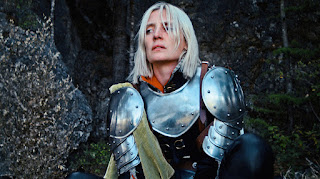
Like Dumont, Rivette took a tilt at the Joan of Arc story, and while his two-part epic Joan the Maid's influence can be seen in Schmitz's film, it is actually Rivette's more overtly theatre-centric works such as L'Amour fou and Va savoir that inform Lucie Loses Her Horse's exploration of the slippery relationship between theatre and cinema.  Even the title of Schmitz's film is positively Rivettian, although if you waited around three hours to see Celine and Julie Go Boating's title characters finally jump in a vessel and take to the water, rest assured that Lucie (Lucie Debay, terrific) and her equine companion are parted in the early stages of Schmitz's sly, playful work.  Upon losing her not so trusty steed, Lucie—kitted out in a fine suit of armour—promptly begins searching for the animal, in the process encountering two other female knights (Hélène Bressiant, Judith Williquet), both of whom have also managed to become separated from their horses.  To lose one horse may be regarded as a misfortune, etc... actually, that quote doesn't quite fit this scenario—but hopefully you get the idea.


This medieval-themed episode comes wedged between two very different sequences: in the prior one, we witness Lucie the actress saying goodbye to her young daughter (Nao Wielemans-Debay) before she heads off to work; in the second, Lucie and the other two horseless knights—who, as it turns out, are fellow actresses—wake up in a theatre in which they're playing in a production of Shakespeare's King Lear.  In case you don't count this as sufficiently meta, consider that Lucie's child is played by Lucie Debay's real-life daughter (Debay's partner is musician Antoine Wielemans, of Belgian indie act Girls in Hawaii), and also that Lucie Loses Her Horse morphed out of one of Schmitz's theatrical productions, Un Royaume, whose performances were truncated on account of the coronavirus pandemic.  That one of the film's production companies is Le Théâtre de Liège, who staged the play on which the film is partly based, demonstrates how blurred the lines have become between the two works (and, by extension, the two media).


Before we get to thinking of where the MacGuffin that is Lucie's horse may have wandered off to, is it at all possible to establish which if any of these incarnations is the real Lucie?  Is all the knights and horses stuff part of a fugue state, or simply another performance by the actresses?  And does it really matter?  Much of the film focuses on the increasingly chaotic backstage drama that unfolds at the theatre, most of which is fairly inconsequential yet oddly compelling.  What we have here is essentially a shaggy dog story, one which remains completely absorbing should you allow yourself to go along with the joke.  With Lucie Loses Her Horse, Claude Schmitz has planted one foot firmly in cinema and the other in theatre, resulting in both a deeply strange hybrid work and an alluring twilight world; it's a film as mischievous as it is haunting, and one strongly suspects that the late M. Rivette—Saturday past marked the sixth anniversary of his death—would have greatly enjoyed this unique meditation on theatre and cinema.  

Darren Arnold

Images: IFFR

Saturday, 9 October 2021

Our Men (Rachel Lang, 2021)


In Christophe Honoré's superb 2007 film Love Songs—arguably its director's finest work—Louis Garrel, in a scene as moving as it was unusual, employed the NATO phonetic alphabet to convey the death of his girlfriend.  In a remarkable coincidence, and for very similar reasons, Garrel also uses the same code, "Delta–Charlie–Delta" ("décédé", meaning deceased), in Rachel Lang's Our Men, where its use is no less haunting.  In Our Men, Garrel stars as Maxime, a French foreign legion commanding officer who's leading a tricky mission in Mali; when one of his men is killed during an ambush by Islamic insurgents, it's down to Maxime to report the death and here, as in Love Songs, Garrel puts his intense features to good use as he grimly relays the news.  


Garrel's turn in Our Men provides a reminder of both the sort of part he's been offered in recent times, and how these roles differ from his work as a younger man; his early appearances in the likes of Honore's Ma Mère and Bernardo Bertolucci's The Dreamers saw the actor cast as louche, erratic types, but more recently the tendency has been to match him with relatively upright roles, such as when he played Alfred Dreyfus in Roman Polanski's absorbing J'Accuse.  The steady Maxime is a fairly typical part for the Garrel of today, even if the actor can still rise to the challenge when tasked with channelling his inner weasel, as evidenced in Woody Allen's most recent film, Rifkin's Festival.  But Garrel has done well to avoid the sort of typecasting that once seemed inevitable, and he's always an engaging, watchable presence.  Maxime's wife, Céline, is played by the excellent Camille Cottin, a performer who, like her co-star, has worked with Christophe Honoré; also as with Garrel, Cottin has successfully edged away from her earlier roles, with a recent string of dramatic parts demonstrating a range beyond comedy.  


While Garrel and Cottin are the two biggest stars in the film—which also features Lucie Debay and Claire Denis mainstay Grégoire Colin in supporting roles—their characters make way for a younger couple, Ukrainians Nika and Vlad (Ina Marija Bartaité, Aleksandr Kuznetsov).  The taciturn Vlad is under Maxime's command, and Nika, who has only recently arrived on the army base in Corsica, soon befriends busy, affable lawyer Céline, who asks Nika if she would be interested in babysitting her and Maxime's son; it is through this job that Nika gets to know some of the other legionnaires' wives.  With Vlad away on duty, Nika cuts a rather lonely figure, and even on the few occasions when Vlad returns home, he seems distant and is reluctant to discuss Nika's hopes of starting a family.  Vlad does buy a puppy, however, and this very cute canine does provide good company for Nika as she fills her long days.  But Nika still feels rejected by the absent Vlad, and the welcome attention she receives from another man leads to a rather predictable complication.      


With its focus on the soldiers' partners in general and Nika in particular, Our Men may surprise those expecting to see wall to wall scenes of warfare; while the film does indeed spend some time "over there", the combat never feels especially authentic, so it's probably just as well that the real meat of the story takes place away from the warzone.  Our Men, which screens this weekend at the London Film Festival, is a strong film, but sadly it seems inevitable that its release will be overshadowed by the death of its young star: six months ago, Ina Marija Bartaité was killed when a drunk driver knocked her off her bicycle.  This tragedy occurred ten years on from the untimely death of Bartaité's mother Yekaterina Golubeva, who, as well as starring in Bruno Dumont's Twentynine Palms and her partner Leos Carax's Pola X, appeared in two films by the aforementioned Claire Denis.  It is not inapt to suggest that Denis' Colin-starring Beau travail—one of the most memorable films about life in the foreign legion—would form a fine double bill with the engrossing, affecting Our Men.

Darren Arnold

Images: BAC Films

Monday, 29 June 2020

King of the Belgians (J. Woodworth / P. Brosens, 2016)


King of the Belgians, which stars Lucie Debay and can be bought or rented here, is a road movie in which a dormant King gets lost in the Balkans and awakens to the real world. King Nicolas III is a lonely soul who has the distinct feeling he’s living the wrong life. He embarks on a state visit to Istanbul with a British filmmaker, Duncan Lloyd, who has been commissioned by the Palace to shoot a documentary intended to polish the monarch’s rather dull image.

The news breaks that Wallonia, Belgium’s southern half, has declared its independence. The King, bursting with purpose, must return home at once to save his kingdom. And for once, he declares, he will write his own damn speech. As they rally to depart, a solar storm strikes the earth causing communications to collapse and airspace to shut down. No phones. No planes. To make matters worse, Turkish security coldly dismisses the King’s suggestion they return home by road. But the King has no intention of waiting out this storm. Lloyd, sniffing an opportunity of historical proportions, hatches a dubious escape plan that involves flowery dresses and singing Bulgarians.

Thus begins their undercover odyssey across the Balkans, a journey that’s loaded with wrong turns, startling encounters and moments of fleeting joy.

Director's Statement:

An Icelandic volcano erupted and an idea was born: let’s drop a Belgian King in Istanbul, stir up a natural disaster, spark a political crisis and then launch him on a homeward overland journey, incognito, that features trip-ups, show-downs and moments of grace. Displacement as the essence of comedy, in other words. 

The challenge was how to actually tell this tale... The Royal Palace hires Duncan Lloyd, a Brit, to upgrade the King’s image. Nicolas III is a lonely soul who drifts through the motions of protocol and is largely kept silent. His unexpected odyssey through the Balkans causes him to question his worldview and to ponder his awkward place in the universe. He is but a man. But he is also a King. What could or should that mean in such fragile times? Lloyd’s lens is the sole prism through which we experience these six extraordinary days in the life of a King. 

And what about Belgium, a complicated little country that specializes in surrealism and compromise? The ongoing political turmoil in our peanut kingdom and Europe’s ever-deepening identity crisis were a key source of inspiration. But the political tangent of the film remains secondary to the inner transformation of the King as he savors his anonymity and begins to discover his genuine yearnings. 

To enhance authenticity and spontaneity we often invited the actors to improvise. And we filmed chronologically. The situations become increasingly outrageous but actually remain delightfully believable. The result is King of the Belgians, a road movie about a wayward monarch profoundly lost in the Balkans.

Source/image: Flanders Image