Sunday, 8 October 2023

LFF 2023: The Taste of Mango


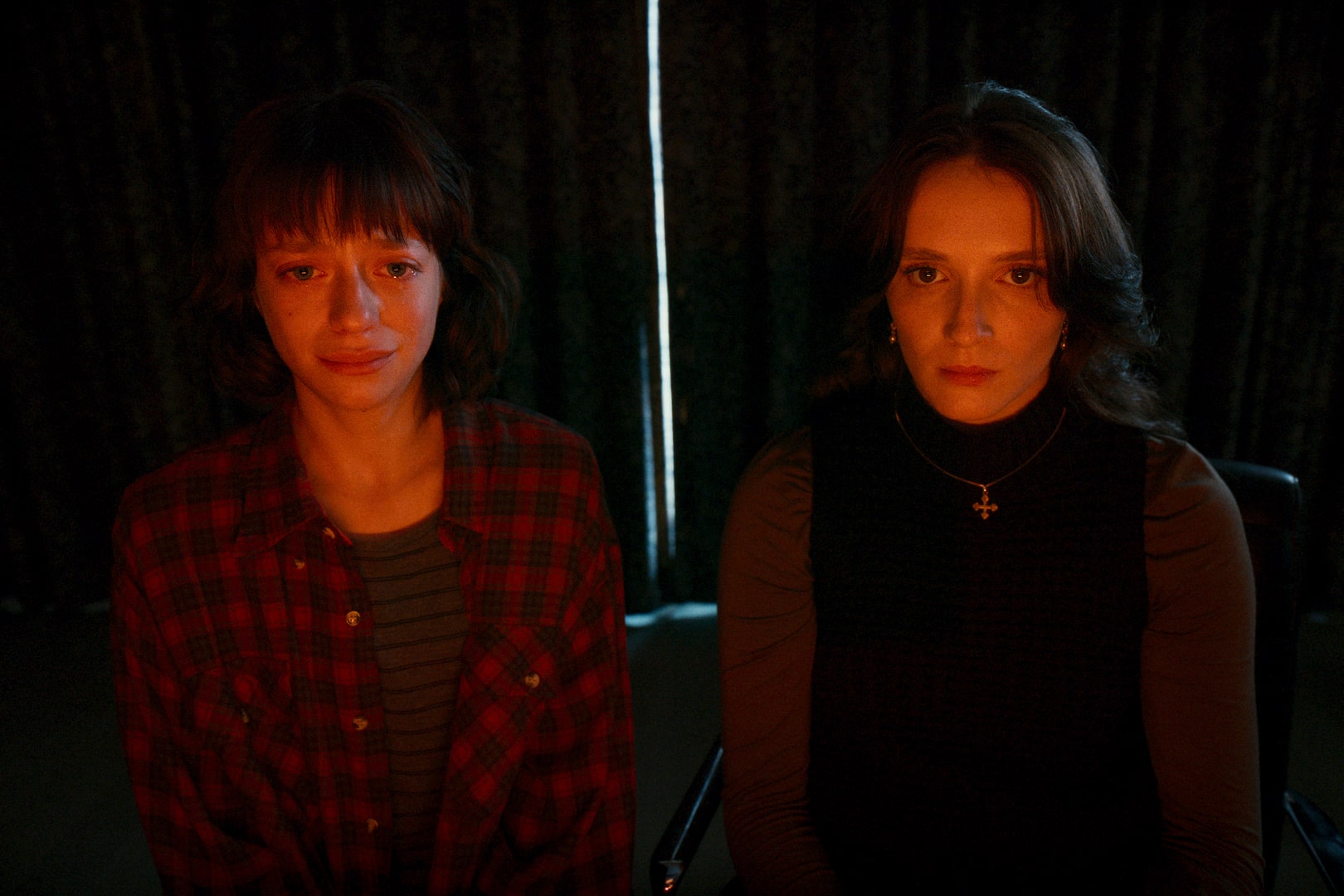
Chloe Abrahams' striking debut feature The Taste of Mango plays tomorrow as part of this year's BFI London Film Festival, where it screens in competition for the Grierson Award.  Abrahams' film comes up against a strong field of documentaries, which includes Leandro Koch and Paloma Schachmann's The Klezmer Project, Cyril Aris' Dancing on the Edge of a Volcano, and Sav Rodgers' Chasing Chasing Amy.  Yet the film in the documentary competition that The Taste of Mango has most in common with is Lina Soualem's Bye Bye Tiberias: both films are highly personal explorations of their makers' respective relationships with their mothers (in Soualem's case, her mum is famous Palestinian actor Hiam Abbass, who has appeared in the likes of Munich, Blade Runner 2049, Miral and last year's Hellraiser remake).


Abrahams was raised in the UK by her mother Rozana, who moved to England from her native Sri Lanka in order to escape a very specific problem.  While the film's focus is very much on the loving relationship that exists between the director and her mother, Chloe Abrahams widens her scope to involve another generation of her family, who are represented by her grandmother (and Rozana's mother) Jean.  It is through Jean's inclusion that The Taste of Mango takes its darkest turn, as it is revealed that her husband subjected Rozana, his stepdaughter, to years of physical and sexual violence, thus prompting Rozana to leave Sri Lanka when the opportunity arose.  In the years that followed, Rozana, quite understandably, became estranged from her mother, and she still can't fathom why Jean—who is fully aware of the abuse that occurred—remains married to this man.


While Rozana's relationship with Jean has since thawed to the extent that the latter can now visit her daughter and granddaughter in London, it's abundantly clear that much remains unresolved.  On camera, Jean herself comes across as both personable and affable—but it is hard to reconcile this person with the one who has consciously stayed with a man who inflicted such horrors on the young Rozana.  Although several decades have passed, Rozana hasn't completely given up on the possibility that her mother might one day leave her husband; Jean's persistence with the marriage can largely be attributed to that most banal of reasons: the need to maintain appearances.  Rozana is a luminous, wonderfully gracious presence, and both the love and life she's given to Chloe stand in stark contrast to her own terrible experiences back in Sri Lanka.     


Despite the closeness that exists between Chloe and Rozana, The Taste of Mango is also about distance, specifically the silent gap that lies between children and their parents; while the reason for the rupture in Jean and Rozana's relationship is obvious, there's the subtler example of Chloe's frustration as to why her mother won't do more when it comes to addressing the demons of the past.  Then there's the series of tangible gaps we witness early on in the film, as one of Rozana's family albums is littered with empty spaces created by the numerous photos that have been torn to omit her abuser; our eyes are instinctively drawn to the redacted areas.  While the absence of Rozana's stepfather from these pictures serves to highlight his unfortunate impact on her life, this photo album can conversely be viewed as symbolic of the survivor's life today, in which there's only room for the good things.  This is a moving, lyrical and haunting film; don't bet against it walking away with the Grierson Award. 

Darren Arnold

Images: BFI

Friday, 6 October 2023

LFF 2023: Red Rooms


Canadian filmmaker Pascal Plante made quite a splash on the festival circuit with his two previous narrative features, Fake Tattoos and Nadia, Butterfly, which competed at Berlin and Cannes, respectively.  In keeping with this trend, Plante's latest film, the compelling, unsettling Red Rooms (French: Les chambres rouges) has been selected for the BFI London Film Festival, where it screens out of competition as part of the Cult strand on Sunday, October 8 and Monday, October 9.  Red Rooms' appearance at the LFF comes just a few months on from its world premiere at the Karlovy Vary International Film Festival, where it vied for the festival's Crystal Globe; while it ultimately fell short in its bid to secure the KVIFF's main award (which went to Blaga's Lessons), the film's presence at both Karlovy Vary and London cements its director's position as a European festival mainstay.


The LFF's Cult section, while always worth a perusal, is particularly strong this year, with Red Rooms taking its place alongside the likes of Bertrand Bonello's keenly anticipated The Beast, Frankenstein riff Birth/Rebirth, and belated sequel Nightwatch: Demons Are Forever.  With its firm emphasis on the aftermath of violence, the highly implicit Red Rooms has a connection to another Francophone title from this year's LFF: The Spectre of Boko Haram.  While, on the face of it, Plante's film has little for gorehounds to sink their teeth into, its non-transgressive appearance should fool no one: the black-hearted Red Rooms is strong meat, and a difficult film to shake off.  It is anchored by a terrifically unnerving performance from Juliette Gariépy, who stars as Kelly-Anne, a successful model who spends virtually all her spare time following every detail of the trial of Ludovic Chevalier (a wordless turn from Maxwell McCabe-Lokos), who is charged with the brutal murders of three young girls.    


The trial of Chevalier proves to be something of a media circus, and Kelly-Anne regularly camps out in the cold in order to secure a spot in the public gallery.  It is while waiting for entry into the courthouse that Kelly-Anne meets Clémentine (Laurie Babin), a virtually penniless young woman who is convinced of Chevalier's innocence.  The rather taciturn Kelly-Anne tentatively strikes up a friendship with the chatty, slightly jittery Clémentine, who eventually takes up Kelly-Anne's offer of a place to stay for the remainder of the trial.  We hear graphic descriptions of the murders, all of which are revealed—in one of the film's queasiest developments— to have been broadcast live to one of the darkest corners of the internet, to which the highly tech-savvy Kelly-Anne has access.  Footage of two of the killings is used as evidence in the trial, yet the the third murder video has eluded everyone; while attempting to locate the missing recording, the dogged Kelly-Anne—who has accrued a sizeable pot of cryptocurrency through online poker—puts herself in real danger.   


But what exactly is Kelly-Anne's interest in this particularly grim case?  As Red Rooms begins, this wealthy model could easily pass for a relative of one of the victims, but she soon emerges as a more militant take on Clémentine's murder groupie.  Kelly-Anne's full-bore devotion to the cause—which culminates in a nightmarish, jaw-dropping scene that sees her dragged from the courtroom—leads to a rift with her justifiably alarmed agent, while the previously bellicose Clémentine refuses to cross a line that her host has long since breezed past in the quest to discover the truth about these crimes.  Yet it is not the fate of Chevalier but rather the mystery of what makes the inscrutable Kelly-Anne tick that gives this deliberately paced film its dramatic heft, and Pascal Plante keeps us guessing until just before the final credits roll.  Red Rooms' suggested atrocities instil a rising tide of anxiety that makes for a nerve-shredding couple of hours; this claustrophobic horror is a masterclass of less is more filmmaking, and is quite unlike anything in recent film history. 

Darren Arnold

Images: BFI

Wednesday, 4 October 2023

LFF 2023: The Spectre of Boko Haram / Making Babies


Cyrielle Raingou's debut feature The Spectre of Boko Haram (French: Le Spectre de Boko Haram) won the Tiger Award at this year's International Film Festival Rotterdam, and it continues its way around the festival circuit with outings at the BFI London Film Festival, where it screens on Thursday, October 5 and Friday, October 6.  Although Raingou's film won the IFFR's flagship prize, it is not in competition at the LFF but rather finds itself in the festival's Journey strand, where it is joined by fellow documentaries The Echo and Ramona.  Cameroon native Raingou cut her teeth on short films including The Lamb, Challenge and Requiem Prologue, before moving into long-form filmmaking with her Rotterdam winner, a work which documents daily life in Kolofata, a village in the director's home region.   


Kolofata is a northern Cameroonian commune which sits close to the Nigerian border; for many years, the militant Islamist organisation Boko Haram has been based in Nigeria, but their reach extends to neighbouring countries Cameroon, Chad and Niger, as well as the latter's neighbour, Mali.  Kolofata has come under attack from Boko Haram on more than one occasion, and judging by the heavily-armed soldiers who guard the perimeter of the village's school, it seems that no one is discounting the possibility of future assaults on the town.  The film focuses on three children—Falta, Mohamed and Ibrahim—as they go about their everyday activities in the face of the fallout from Boko Haram's actions; Falta's father was killed by a suicide bomber, while Nigerian brothers Mohamed and Ibrahim are separated from their parents.       


Given both its success at Rotterdam and the subject matter, The Spectre of Boko Haram is an unexpectedly muted film; while it's an assured, fitfully engaging documentary, the style is televisual, and the filmmaking rarely rises to anything beyond workmanlike.  It's a sober, low-key work, one in which Cyrielle Raingou is bent on showing the lasting effects of conflict, while the violence itself is all but sidelined.  In accord with the film's baldly descriptive title, Boko Haram is an undeniable, unsettling presence here: never at the forefront of proceedings, but always lurking around the margins of the quotidian.  Moreover, Raingou provides virtually no context or background on Boko Haram's activities, which underlines her steadfast dedication to prioritising victims over perpetrators.     


Sticking with Francophone cinema, and Canadian short Making Babies (French: Faire un enfant) screens today as one of half a dozen films included in the LFF's What Makes Us programme.  Making Babies is written and directed by Eric K. Boulianne, a prolific screenwriter who is perhaps best known for co-writing Michel Côté-starrer De père en flic 2.  Here, Boulianne himself stars alongside Florence Blain Mbaye, with the pair playing a nameless couple who, as per the title, are making an effort to get pregnant.  After numerous tries—an on-screen counter keeps track of the attempts—and no progress, the stressed-out couple opts for fertility treatment, which brings no change in fortune but does put even more strain on the relationship.  This funny, moving and well-judged film proves just long enough to make its emotional point, with Boulianne turning in great work on both sides of the camera.  

Darren Arnold

Images: BFI