

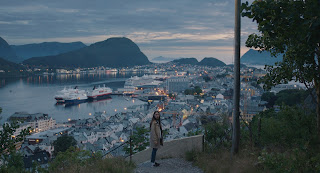
As with his 2018 debut feature Hurry Slowly, A Human Position—currently screening at the International Film Festival Rotterdam—sees director Anders Emblem firmly on home territory in the western Norwegian town of Ålesund; in a further parallel with Hurry Slowly, A Human Position's leading role is played by Amalie Ibsen Jensen. The excellent Jensen brings a haunted quality to the troubled Asta, a young journalist working for an Ålesund newspaper, for which she reports on matters including football, proposed redevelopment, and the various cruise ships lined up in the town's expansive port. Asta performs well in her job, one which appears to serve as a welcome distraction from some darker issues lurking around the edges of the reporter's life; in one scene at the home she shares with upholsterer/budding musician Live (Maria Agwumaro) and an incredibly cute cat, Asta is shown applying some sort of cream to her stomach before she turns in for the night.

While most of the stories covered by Asta leave little in the way of a lasting impression on the young woman, things change when she stumbles across the sorry tale of Aslan, an asylum seeker who once worked in the town but has since vanished; word is that Aslan has been deported, but Asta senses that there's something more to the story. As she digs deeper into the mystery, Asta encounters much in the way of red tape, and she speaks to several town officials, all of whom seem to have mastered the art of talking a lot while saying nothing. Yet the passive aggressiveness that meets these enquiries does little to deter Asta, who doggedly sticks to piecing together Aslan's movements in the time leading up to his disappearance. As with Antonioni's L'Avventura, there's a nagging feeling that this puzzle is one bound to remain unsolved.

While A Human Position feels far from didactic—Emblem largely invites the viewer to interpret the film however they like—it implies that Aslan's fate is the fault of both everyone and no one. As such, it recalls Michael Haneke's The White Ribbon, a film that cast a cold, unblinking eye over the notion of collective responsibility (or lack of it). The wealth and stability of Norway stand in sharp contrast with the circumstances that the unseen Aslan sought asylum from (and has purportedly been returned to). It is to the film's great credit that we get a real sense of the missing man, and just as Asta seems to make a tangible connection to him via the chair favoured by Aslan during his work breaks, the viewer is able to form a picture of this notable absentee (his choice of seat highlights an obvious motif in A Human Position, given that Asta and Live's home is scattered with chairs in various states of repair). Asta, unlike many others in her hometown, has opted to be interested in Aslan's story, and this same choice is extended to the viewer.
Darren Arnold
Images: Alibi Communications


